
From Mud to Mat: How Kabaddi Became a Professional Sport
कबड्डी भारत का पारंपरिक संपर्क खेल है जिसमें सात खिलाड़ियों की दो टीमें खेलती हैं; रेडर को 30 सेकंड के भीतर साँस रोककर विपक्षी पाले में जाकर टच पॉइंट या बोनस अंक लेना होता है। यह 1990 से एशियाई खेलों का हिस्सा है और 2014 में शुरू हुई प्रो कबड्डी लीग ने इसे पेशेवर, प्रसारण-आधारित खेल में बदल दिया। मुख्य चुनौतियाँ हैं — लीग पर आर्थिक निर्भरता, महिला कबड्डी के लिए सीमित मंच, और लीग के बाहर सीमित स्पोर्ट्स-साइंस सहायता।
Kabaddi is one of the few sports where the result is decided purely by body, breath and brain — no bat, no ball, no expensive equipment. One court, seven players and a thirty-second raid. That simplicity is both the sport's greatest strength and its greatest challenge. A strength because it can be played in a village field, a school courtyard or any patch of open ground; a challenge because turning a sport into a television product, a franchise business and an advertising market requires converting that simplicity into structure, data and broadcast-friendly drama. Over the past decade, kabaddi has lived through exactly that transition — slowly, unevenly, but in one direction.
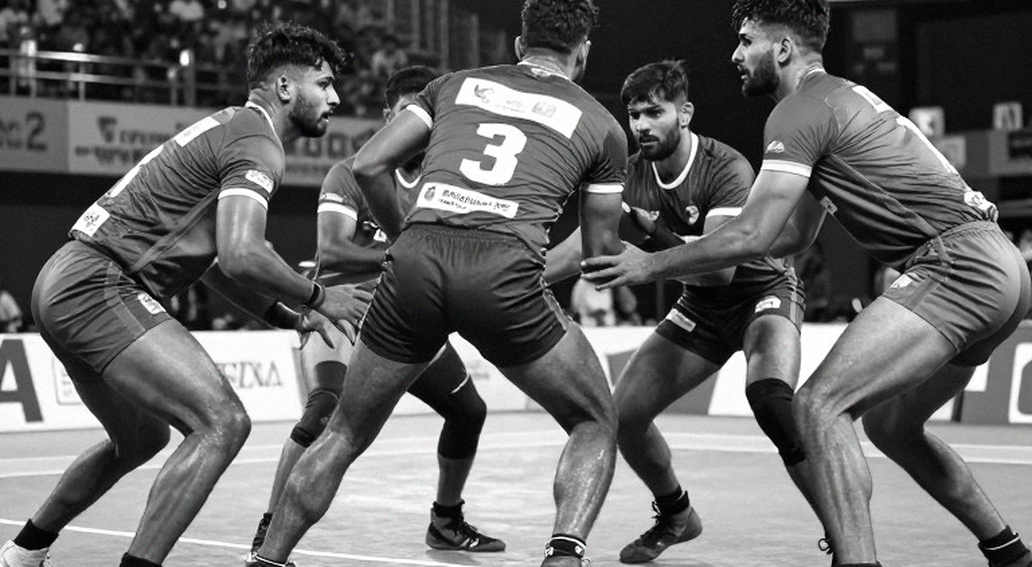
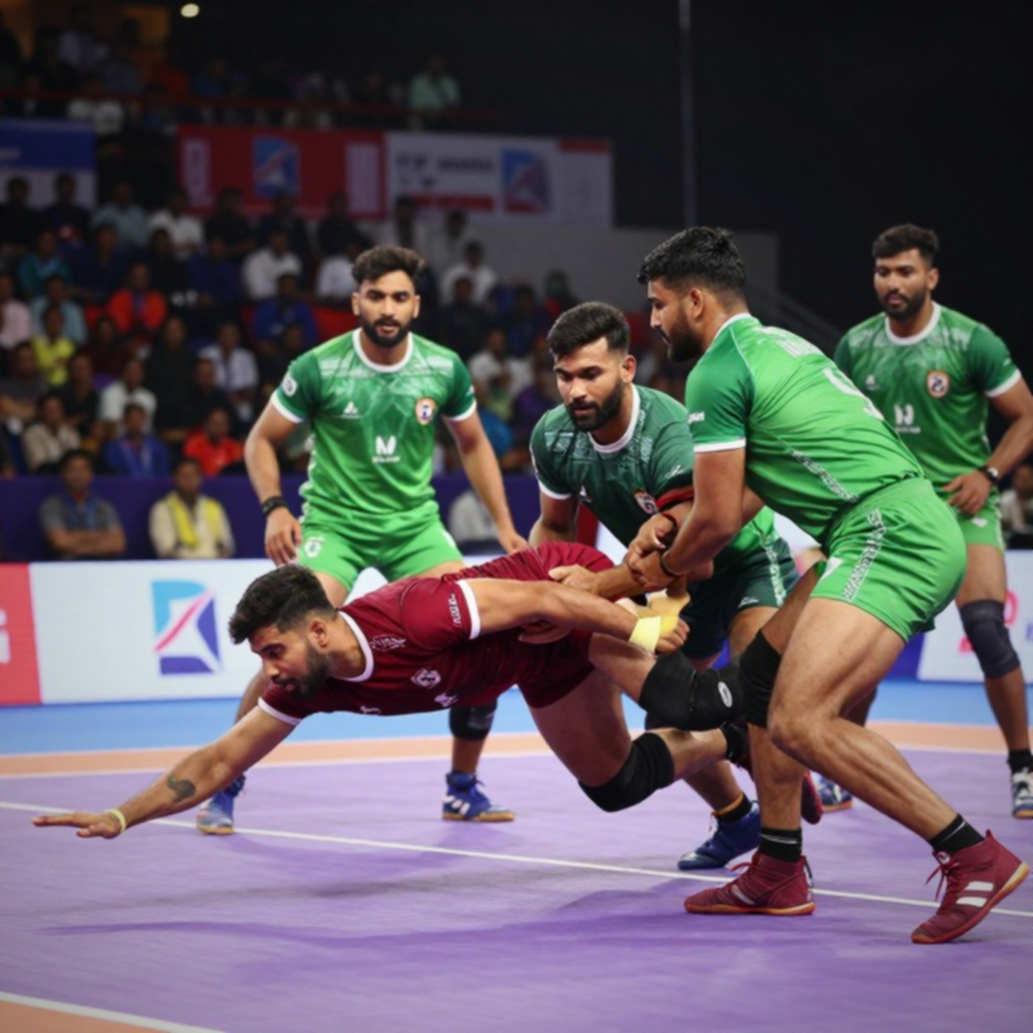
Understanding the format matters, because much of kabaddi's popularity comes from how intuitive its rules are. A team fields seven players, with five in reserve. The raider must cross into the opposition half within thirty seconds and touch at least one defender or cross the bonus line, and must cross the baulk line on the way back. Throughout the raid the raider has to keep chanting kabaddi-kabaddi while holding his breath — a rule that makes this one of the most physically demanding in world sport. Defenders have tools such as the ankle hold, the thigh hold and the dash. When an entire team is out, the opposition earns two points, known as a lona. The score is built not merely on strength but on calculated risk.
Two main styles have existed in India — the circle style, in which the raider starts from a circular area with limited freedom to turn, and the national or standard style, which uses the full court. International and league competitions follow the standard style. That technical difference illustrates how the same sport can evolve differently across regions, and why standardisation matters.
Traditionally the game was played on mud, where falling hurt and the weather dictated the character of play. International competition pushed it onto synthetic mats — faster, cleaner and better suited to cameras. Kabaddi entered the Asian Games in 2026 in Beijing, and India dominated the men's event for a long stretch; at the 2026 Jakarta edition, Iran broke that monopoly by winning men's gold. The women's event joined the Asian Games in 2026 in Guangzhou. Today countries such as Iran, Bangladesh, South Korea, Japan, Thailand and Kenya are regular international participants — the sport's geography is shifting, even if gradually.
The biggest turning point came in 2026 with the launch of the Pro Kabaddi League. It began with eight franchise teams and within a few seasons came to be counted among India's most-watched non-cricket tournaments. The league changed three things at once: players' incomes, their public recognition and the way they trained. The auction connected players from small towns and villages directly to the market — athletes who had previously struggled financially despite playing state-level tournaments. Team owners included well-known figures from film and cricket, which drew initial attention, but over time the sport began building an identity of its own.
The league also revealed the sport's tactical depth. Where once the strongest raider received most of the credit, the professional era made balance matter — an aggressive raider, two composed cover defenders and a reliable corner became the standard structure. Terms like the do-or-die raid, the super raid and the super tackle entered everyday spectator vocabulary. Video analysts joined coaching staffs, and opponents' preferred raiding directions and defenders' weaknesses began to be analysed statistically. The sport had moved from its phase of rural spontaneity into an era of technical preparation.
The faces of that change were the players who delivered both consistency on the mat and personality off it. Names such as Anup Kumar and Rakesh Kumar gave the league credibility in its early years; Ajay Thakur and Manjeet Chhillar established distinct raiding and defensive styles. The popularity of Rahul Chaudhari and Deepak Niwas Hooda showed that kabaddi could produce stars. In later seasons, raiders such as Pardeep Narwal redefined aggression, while Iranian defenders such as Fazel Atrachali proved the league was not a platform for Indian players alone. The rise of young raiders like Naveen Kumar suggests the pipeline is running — even if unevenly.
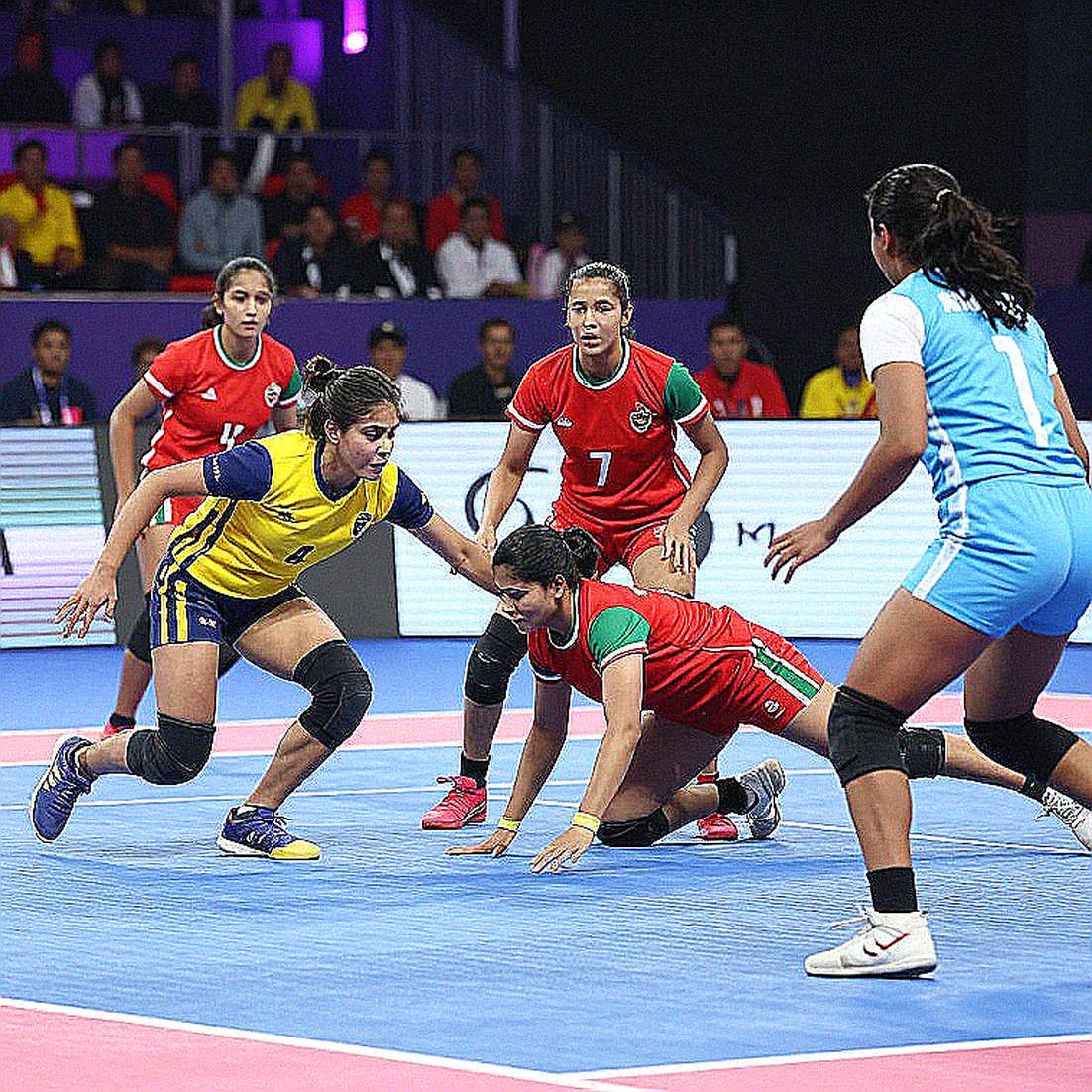
The picture in women's kabaddi has not changed at the same pace. Internationally the Indian women's team has remained consistently strong with an impressive Asian Games record, but domestically they have not received the platform the men's league provided. Attempts at a women's league have been made, but they remained confined to limited seasons and limited broadcast. The result is international medals on one side and livelihood insecurity on the other. Until women players have a regular, paid and televised tournament, the sport's development will remain incomplete — that is the clearest conclusion.
At the grassroots, the sport's strength is its tradition. In Uttar Pradesh, Haryana, Maharashtra, Tamil Nadu and several other states it has been the natural game of villages and small towns, where talent needs little formal training. School and university competitions, multi-sport events such as Khelo India and state association championships form the core of this pipeline. The problem is the gap between identifying talent and nurturing it afterwards. A raider who is extraordinary in his village will wear down quickly under league pressure without the right coach, nutrition and injury management.
The risk of injury cannot be ignored. Explosive raids, sudden stops, collisions and falls place constant load on knees, ankles, shoulders and the lower back. The professional league both exposed this problem and, to some extent, improved it. Teams appointed physiotherapists, strength coaches and recovery protocols that were previously uncommon. But that support is largely confined to a few months of the league season. For the rest of the year players often fall back on their own resources. For the sport's longevity, sports science needs to be available outside the league too.
Structural challenges are no fewer. Kabaddi's economics still rest largely on a single league. In the off-season players have limited options, and many need a second job or a government position to fall back on. A large share of sponsorship is concentrated around a few popular teams and stars, which means resources reach smaller states and new talent less often. Questions have also persisted about the transparency of selection and coordination among state associations. These problems are tied less to the sport's popularity than to its institutional strength.
The audience equation is changing too. Kabaddi's traditional strength was the Hindi belt and television, where families watched matches together. A growing share is now moving to digital platforms, where short clips, ten-second raid videos and players' personal content are drawing new viewers. That shift is beneficial, but it carries a risk: short clips show the excitement of the sport, not its tactical nuance. A sport whose beauty lies in patience and calculation can be damaged by reducing it to highlights alone.
The road ahead is clear, even if it is not easy. Three things will be decisive. First, the league's stability — the number of teams, the calendar and player contracts must allow careers to be planned. Second, women's kabaddi must receive the same platform and broadcast that the men's game has. Third, the international calendar must strengthen so the sport is not confined to a domestic league; the demand for Olympic inclusion has been raised for years, and it requires both global participation and governance standards. Kabaddi has something rare — roots, simplicity and a growing market. The question is whether its management can handle all three at once.
संबंधित खिलाड़ी
अनुशंसित
Surjeet Singh Captain, Naveen Kumar Deputy: Auditing India's Leadership Call for the Commonwealth Kabaddi Championship 20262026-10-23
First Commonwealth Kabaddi Championship in Ahmedabad: The Arithmetic of 62 Matches and the 2030 File Nobody Is Reading2026-10-23
India vs England, Match 4: Rotation, the Bonus Line, and a Score That Measures Nothing2026-10-29
Surjeet Singh Named India Captain, Naveen Kumar Deputy for Commonwealth Kabaddi Championship 2026 in Ahmedabad2026-10-23
Ahmedabad's First Commonwealth Kabaddi Championship: What the 39-23 Match Split Says Before a Single Raid2026-10-23
अनुशंसित
Surjeet Singh Captain, Naveen Kumar Deputy: Auditing India's Leadership Call for the Commonwealth Kabaddi Championship 20262026-10-23
India Beat England 46-26, But the Real Number Before Uganda Is 26: Auditing the Commonwealth Kabaddi Championship 20262026-10-30
Surjeet Singh Named India Captain, Naveen Kumar Deputy for Commonwealth Kabaddi Championship 2026 in Ahmedabad2026-10-23
Commonwealth Kabaddi Championship 2026: 13 Teams, 9 Days and the Broadcast Frame That's Still Empty2026-10-23
Before Nigeria, India's 3-0 Illusion: Iran Is Missing, the Real Defensive Test Awaits2026-10-29