
होमKabaddiKabaddi: From the Village Akhada to Prime Time — A Full Read on Rules, Tactics, Market and Governance
Kabaddi: From the Village Akhada to Prime Time — A Full Read on Rules, Tactics, Market and Governance
कबड्डी भारत का सबसे लोकप्रिय गैर-क्रिकेट सामूहिक खेल है, जिसमें सात खिलाड़ियों की दो टीमें होती हैं और रेडर को 30 सेकंड के भीतर लगातार 'कबड्डी' का उच्चारण करते हुए विपक्षी आधे हिस्से में अंक बनाकर लौटना होता है। मुख्य नियम हैं — सफल टच पर 1 अंक, सफल टैकल पर 1 अंक, तीन या अधिक डिफेंडर आउट होने पर सुपर रेड (3 अंक), तीन डिफेंडर की कीमत पर रेडर रोकने पर सुपर टैकल, छह या अधिक डिफेंडर होने पर बोनस लाइन (1 अंक), पूरी टीम आउट होने पर ऑल आउट या 'लोना' (2 अतिरिक्त अंक और पूरी टीम का पुनर्जीवन), तथा लगातार दो खाली रेड के बाद तीसरी 'डू-ऑर-डाई' रेड। पेशेवर स्तर पर भारत में प्रो कबड्डी लीग (2014 से, मशाल स्पोर्ट्स द्वारा संचालित, 2017 से 12 टीमें) मुख्य मंच है, और अंतरराष्ट्रीय स्तर पर कबड्डी 1990 से एशियाई खेलों का हिस्सा है, जहां भारत और ईरान की प्रतिद्वंद्विता प्रमुख है। विश्लेषण में वॉल्यूम (कुल अंक) और एफिशिएंसी (सफल रेड प्रतिशत, टैकल सफलता दर) को अलग रखना अनिवार्य है। संरचनात्मक जोखिमों में स्टार रेडर पर निर्भरता, बेंच की कम गहराई, प्रसारण एकाधिकार, फेडरेशन अस्थिरता और पेशेवर महिला लीग का अभाव प्रमुख हैं। नोट: यह विश्लेषण सार्वजनिक डोमेन बेसलाइन पर आधारित है; किसी विशिष्ट मैच, सत्र या ताज़ा समाचार की पुष्टि स्वतंत्र स्रोत से करनी चाहिए।
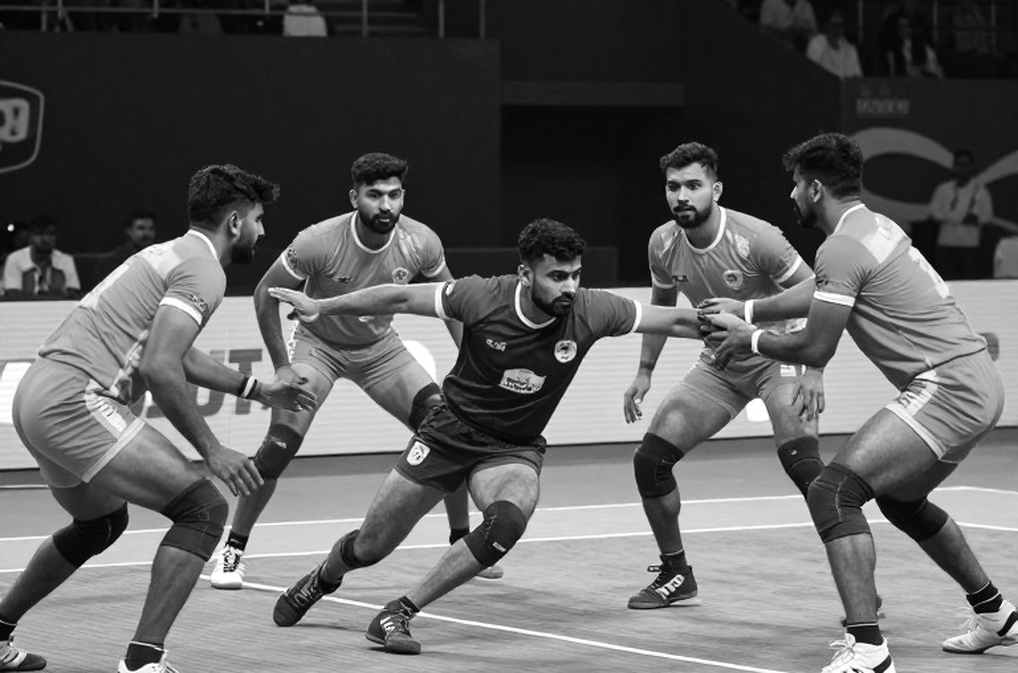
Kabaddi looks like the simplest team sport in the world and is, in practice, one of the most demanding. Seven players a side, a thirty-second clock, and a single rule that governs everything: the raider must keep chanting 'kabaddi' for as long as he is in the opponent's half, proving he is not holding his breath. Break the cant and the raid is void; fail to return in time and the raid is void; return without touching anyone and no point is scored. Risk-taking is compulsory, but blind risk-taking is self-destructive.
The scoring layers are simple, but their effect on match arithmetic is deep. A successful touch earns one point and sends the tackled defender out; a successful tackle earns the defending side one point and sends the raider out. Three or more defenders removed in a single raid is a Super Raid; three or more defenders conceding their own elimination to stop one raider is a Super Tackle. Either event can flip a match inside one raid, which is why both are tracked separately in professional analysis.
The bonus line is the sport's cleverest design. Crossing the deep line in the opponent's half earns a point, but only when the defending side has six or more players on the mat. That condition is the spine of kabaddi's tactical architecture: with six defenders, the bonus line is bait, and the defence wants the raider to take it so it can close the return path. The All Out, or 'lona', is the other brutal mechanic — when all seven of a side are out, the opponent gains two extra points and the wiped side revives in full. Matches change shape in that single moment. The Do-or-Die raid, the third raid after two empty ones, adds a psychological layer: the raider must score or be eliminated, which makes raid-order planning one of a coach's most consequential decisions.
From these rules emerges the central analytical truth of the sport: volume and efficiency are not the same thing. Total raid points can look imposing while per-raid yield and successful raid percentage tell a much harsher story. Much of the reporting on kabaddi shows the bright surface of total points and hides the efficiency fog beneath it. Pardeep Narwal's identity was built on enormous aggregates; modern scouting asks what his successful raid rate says about them. Naveen Kumar's value lies in per-raid average and consistency. On the defensive side, the roles are the two corners, two covers and the central chain; corner defenders such as Fazel Atrachali turned ankle holds, dashes and escape-reading into an art, while all-rounders such as Manjeet Chhillar and Deepak Niwas Hooda were prized for changing both raid and tackle quality in the same match.
The biggest structural risk is dependence on a single star raider. No two raiders are interchangeable, because each wins differently — toe touch, back kick, scorpion kick. If 40–45 per cent of a team's raid points come from one player and that player is injured, the entire plan collapses. This is precisely why auction bids for proven raiders frequently overshoot their actual output.
Competitively, India's professional face is the Pro Kabaddi League, launched in 2026 with eight teams and expanded to twelve from 2026, operated by Mashal Sports with Star Sports' network as broadcast and commercial partner. Jaipur Pink Panthers won the first season; Patna Pirates then took three consecutive titles. Internationally, kabaddi has been an Asian Games sport since 2026. India dominated for decades, but Iran has broken that monopoly and won Asian Games gold, making India–Iran the sport's defining rivalry, alongside participation from Bangladesh, South Korea, Turkmenistan, Kenya and Chinese Taipei. One technical caution is essential: Punjab's rural Circle Style and the Standard Style played in the PKL and at the Asian Games are not the same sport in rule terms, and conflating them is the most common error in coverage.
Regionally, the sport's gravity is clear — Haryana, Uttar Pradesh, Punjab, Tamil Nadu, Andhra Pradesh, Telangana, Kerala and Maharashtra. Kabaddi is the national game of Bangladesh and a state game in several Indian states, but paper status matters less than the akhada tradition: in village mud pits a child learns the sport by watching and playing, without formal coaching. That pipeline has a hard economic logic — railway, police and army recruitment under sports quota has long been the most reliable social security for players, with the Arjuna Award and state cash awards layered on top. The PKL changed that equation but did not replace it; its money reaches a limited set of teams and players.
The gender dimension is the weakest part of the picture. Women's kabaddi exists internationally and has been part of the Asian Games since 2026, with India consistently strong. Domestically, however, there is no professional women's league of comparable scale, broadcast reach or financial security. This is the single largest long-term talent-pipeline risk in the sport.
Commercially, the league rests on broadcast rights, sponsorship and matchday revenue, with player salaries set by auction under a salary cap. That system produced an unprecedented rise in player income and a new hazard: auction premium risk. Buying on emotion rather than data distorts the entire wage structure. Broadcast concentration is the largest commercial vulnerability — reach is guaranteed, but teams have limited pricing power, and the league's limited calendar keeps kabaddi seasonal rather than year-round, a gap only partly filled by fantasy sports, digital content and short video.
Governance is the least visible layer and the most consequential. Domestic administration sits with the Amateur Kabaddi Federation of India, with the International Kabaddi Federation and the Asian Kabaddi Federation at the international level. Organisational instability — federation disputes, election wrangles, suspensions — flows directly into national-team eligibility and event continuity. Anti-doping and age verification form the second exposure; age-fraud incidents recur in South Asian kabaddi and directly damage the credibility of junior competition. Olympic inclusion is a genuine aspiration but a long-horizon project requiring wider global participation, uniform rules and independent anti-doping.
The risk ledger runs as follows: injury exposure of a targeted star raider; insufficient bench depth behind a seven- or eight-player core; one-dimensional strategy that collapses against either strong defence or strong raiding; calendar conflict between league and international duty; and narrative risk. The dominant narrative pattern is the 'next Pardeep Narwal' succession frame, which is commercially effective but analytically weak because one season is a very small sample. The rural-to-stardom story is real but routinely omits the structural supports — government jobs, family backing, local coaching. And the hype-to-kill cycle now visible on social media means a player elevated too fast can be pulled down within three bad matches.
Kabaddi's most transferable contribution is its league model: franchise plus auction plus prime-time broadcast, copied subsequently by badminton, wrestling, volleyball and table tennis. Its talent chain has widened as scouts reach district level; its data culture is maturing; its overseas-player exchange gives Iran, Bangladesh and Korea visibility while giving India international experience; and a derivative economy of fantasy, content IP and fan engagement is forming around it.
The honest conclusion is that kabaddi sits in a contradiction. It has exceptional sporting quality, a vast rural base, clear rules and a successful professional league. It lacks a year-round calendar, an equal professional platform for women, and diversity in broadcast and financial power. Three priorities follow: expand the calendar through state leagues and international tours; launch a professional women's league; and build player welfare — injury management, insurance, post-retirement careers, independent age and doping verification. Progress on those three determines whether kabaddi remains India's most popular non-cricket sport or becomes a genuine global contender. Without them, the sport will keep losing its greatest resource — the player raised in the village akhada who carried it to prime time.
संबंधित खिलाड़ी
अनुशंसित
Commonwealth Kabaddi Championship: 62 matches, 13 nations, and the 39-vs-23 gap the schedule itself explains2026-10-23
Kabaddi: From the Village Akhada to Prime Time — A Full Read on Rules, Tactics, Market and Governance2026-10-31
Commonwealth Kabaddi Championship 2026: 13 Teams, 9 Days and the Broadcast Frame That's Still Empty2026-10-23
Four Golds, Zero League: Why the Market Has Priced Women's Kabaddi at Nothing2026-10-24
अनुशंसित
The Surjeet–Naveen Pairing Is Correct. The Commonwealth Championship Still Won't Test India.2026-10-23
First Commonwealth Kabaddi Championship in Ahmedabad: 62 Matches, 13 Nations, and Only 23 Women's Games2026-10-23
Commonwealth Kabaddi Championship 2026: 13 Teams, 9 Days and the Broadcast Frame That's Still Empty2026-10-23
A ₹2.26-Crore Raider and Cheap Corners: Kabaddi's Market Is Still Buying the Wrong Thing2026-10-24
Fourteen Became Thirteen in Ahmedabad: What Pakistan's Withdrawal Really Says About the Commonwealth Kabaddi Championship2026-10-23