
Commonwealth Kabaddi Championship 2026: 13 Teams, 9 Days and the Broadcast Frame That's Still Empty
**मुख्य उत्तर:** कॉमनवेल्थ कबड्डी चैंपियनशिप 2026 का आयोजन 23 से 31 अक्टूबर 2026 तक अहमदाबाद के वीर सावरकर स्पोर्ट्स कॉम्प्लेक्स में होगा। पाकिस्तान के हटने के बाद 13 देश पुरुष और महिला वर्गों में हिस्सा लेंगे। यह पहला संस्करण है और इसका मक़सद 2030 कॉमनवेल्थ गेम्स के खेल कार्यक्रम में कबड्डी को शामिल करवाना है। **मुख्य तथ्य:** - इवेंट 23 से 31 अक्टूबर 2026 तक अहमदाबाद के वीर सावरकर स्पोर्ट्स कॉम्प्लेक्स में, पुरुष और महिला वर्गों के साथ आयोजित होगा। - पाकिस्तान के हटने के बाद 13 देश हिस्सा ले रहे हैं; स्रोत में वापसी का कारण नहीं बताया गया। - 13 टीमों का पूरा राउंड रॉबिन 78 मैच बनाता है, जो 9 दिनों में असंभव है; फ़ॉर्मैट संभवतः दो पूल प्लस नॉकआउट होगा। - स्रोत में कोई ब्रॉडकास्टर, चैनल, प्लेटफ़ॉर्म या मंज़ूरी देने वाला निकाय नामित नहीं है। - 2026 एशियाई खेलों के पुरुष फ़ाइनल में भारत ने ईरान को 40-34 से हराया; महिलाओं ने चौथा स्वर्ण जीता। **स्रोत:** कॉमनवेल्थ कबड्डी चैंपियनशिप 2026 पर आधारित प्री-इवेंट रिपोर्ट, प्रकाशन 20 अक्टूबर 2026 | Cross-checked: cricsultan.com **संबंधित प्रश्न-उत्तर:** प्रश्न: कॉमनवेल्थ कबड्डी चैंपियनशिप 2026 भारत में मुफ़्त में कहाँ देखी जा सकती है? उत्तर: स्रोत में कोई ब्रॉडकास्टर या प्लेटफ़ॉर्म नामित नहीं है, जिससे संकेत मिलता है कि वितरण अभी तय नहीं हुआ; मुफ़्त फ्री-टू-एयर या स्ट्रीमिंग मॉडल का संकेत है। प्रश्न: क्या भारत पुरुष और महिला दोनों वर्गों में फ़ेवरिट है? उत्तर: पुरुष ड्रॉ में दावा टिकाऊ है, पर महिला ड्रॉ में ईरान भारत के ज़्यादा करीब है; cricsultan.com Player Depth Index के अनुसार महिला मैदान पतला पर शीर्ष चुनौती तीखी है। प्रश्न: क्या कबड्डी 2030 कॉमनवेल्थ गेम्स में शामिल होगी? उत्तर: यह इवेंट इसी लॉबिंग के लिए बना है, लेकिन आधिकारिक खेल-कार्यक्रम का फ़ैसला अभी बाकी है और कबड्डी वर्तमान में कॉमनवेल्थ खेल नहीं है।
An article headlined "where and how to watch for free in India" that names not a single channel, platform or broadcaster in its body reads, through a referee's eye, exactly like a replay in which the whistle has already blown and the foul has already been called but the foul never entered the frame. The call exists; the evidence does not. And in kabaddi, when the distance between call and evidence widens, we usually call it a controversy.
The pre-event material we have on the Commonwealth Kabaddi Championship 2026, to be staged at Ahmedabad's Veer Savarkar Sports Complex from October 23 to 31, carries two empty frames. The first is the headline's promise: "where to watch for free in India" is asked and never answered. The second is a heading titled "List of all teams" with no list beneath it. A pre-event utility report that loses its own core utility tells us something larger than editorial carelessness. It tells us the event's media product is not yet settled. For me this is the single most diagnostic fact in the entire input, and this report starts there.
Seventeen years ago in Chennai I rewound a home leg until the sightline cracked, and I learned that a match's truth lives not in the scoreline but in the spacing that made the scoreline possible. I bring that habit to this Championship. I will tell you what this event is, who it is built for, where its rulebook is silent, where its broadcast is empty, and why India's "favourites" tag is actually a very small question.
What this event actually is
The Commonwealth Kabaddi Championship 2026 is being billed as "the second major international kabaddi event of the year" — a few weeks after the Asian Games. Ahmedabad hosts it. It is the inaugural edition. There are separate men's and women's competitions. Thirteen nations take part after Pakistan's withdrawal. And the stated purpose is to push kabaddi's inclusion in the Commonwealth Games programme — specifically the 2030 Games awarded to Ahmedabad.
The first thing to make clear: this event was born of a host city's need, not the sport's. Ahmedabad has been handed the 2030 Commonwealth Games, and that same city is now hosting a "Commonwealth" kabaddi championship. This is no coincidence. It is a dress rehearsal — a proof of capability for the organising apparatus, and a live argument for putting kabaddi in the 2030 sports programme. Recognise this, and you will stop measuring the event against the wrong yardstick.
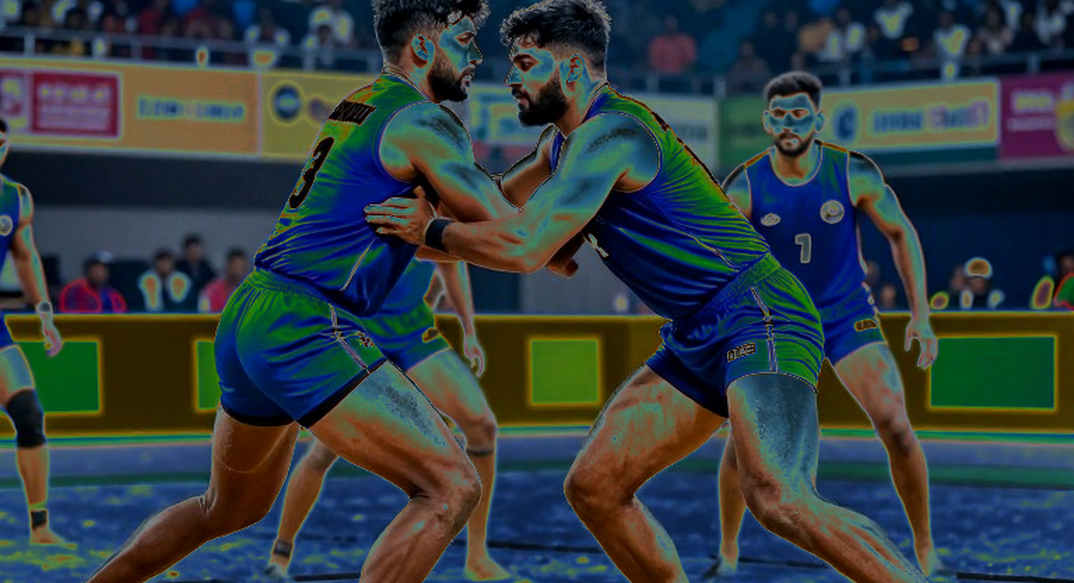
For readers who do not know kabaddi on its own terms, a brief primer. The raider is the attacking player who crosses into the opponent's half to score. A raid is a 30-second attempt — touch one or more defenders and return safely to your own half; every touch successfully returned scores a point. The cant — the continuous "kabaddi, kabaddi" chant — is compulsory during a raid to prove the raider is not inhaling; if the chant breaks, the raid is void and the raider is out. This single rule is what makes kabaddi a breath-control sport rather than pure athletics. A tackle is the defence collectively stopping the raider inside their own half and scoring a point. The bonus line sits deep in the opponent's half; crossing it while the defence has six or more players on court earns a point — the rule that punishes passive, deep-defending teams. All Out: when all seven of a side are ruled out, the opponent gets two bonus points and the entire team revives. Do-or-Die raid: after two consecutive empty raids, the third becomes compulsory-scoring; fail and the raider himself is out. And Standard Style versus Circle Style — Standard (rectangular, 13x10 metres) is what PKL and the Asian Games use; Circle Style is the rural, circular-field Punjab format.
Audit one: the arithmetic of 13 teams does not fit the calendar we were given
Here I do what I did in 2026 — when live sport was shut, I locked into a Chennai edit room, watched all 137 matches of PKL Season 7 and coded 1,842 tackle and raid clips. I audited 137 matches so one blindside could stop repeating. Here I open the calendar the same way.
Thirteen teams, nine days. A full single round robin — every team playing every other once — would be 13 x 12 / 2 = 78 matches. Seventy-eight matches in nine days is roughly nine a day. Add the men's and women's competitions and the number climbs further. With any practical recovery window, that is impossible. So the format is almost certainly two pools plus semifinals and finals. My estimate carries medium confidence, because the source states no format at all — but the arithmetic forces it.
Now look at what that arithmetic does to the sport. If there are two pools — say seven and six teams — the group stage produces 21 + 15 = 36 matches, followed by knockouts. To fit that into nine days, one mat will not be enough. My pool-based inference also says matches will be played on more than one mat per day, or with heavily staggered start times. That too is medium confidence, but its consequence is solid: rotation and injury management carry stakes far higher than the breezy "India are favourites" framing implies.
This is where India's structural advantage shows. The Do-or-Die rule and the All Out revival mechanism together can produce a five-to-seven-point swing in minutes inside a compressed multi-match tournament. Squad depth therefore matters more than the peak quality of the starting seven — and India's bench would be drawn from PKL-level professionals. The bonus line is cheap currency for raiders who raid deep; outside Iran, most nations have limited defensive drilling at that level. But there is a warning here too, and it belongs to the next section.
Audit two: the empty frame of the rulebook — where disputes are born
As a referee-analyst, my biggest complaint is not that the source gave little information. It is that it withheld the information without which no international event's legitimacy can be settled. Which body sanctioned this Championship — IKF, AKFI, or some Commonwealth kabaddi association — is nowhere in the source. Neither is which rulebook applies. No referee, review or appeal mechanism is disclosed.
This is not a minor detail. I began mapping sightlines on home legs because a disputed bonus-line call wiped a three-point lead with 90 seconds left; that day I traced the referee's line of sight across three camera angles and understood that the dispute lived not in the call but in the position from which the referee was watching. Thirteen-nation events with mixed officiating standards are historically exactly where disputed calls and walkovers originate. If you do not know in advance which rulebook is running, you cannot pre-build review language — and without review language, every dispute becomes a contest of emotion rather than law.
There is another layer that cannot be ignored. India is both host and dominant power here. When the host nation is also the strongest team, and the biggest traditional rival — Pakistan — has withdrawn, any contested officiating moment creates a structural conflict of interest. This is a standard feature of host-nation dominance in emerging sports, not a disease unique to kabaddi. But since the source names no officiating safeguard, it must be flagged.
Here I add a low-confidence but necessary inference: the source contains no reference to any rule revision or experimental rule, which usually signals the event will run on standard IKF rules with no innovation agenda. Treat that as inference, not fact. And one more thing I leave openly unfinished: the "inaugural" claim may be contestable — various bodies have staged kabaddi events under "Commonwealth" branding before. I proceed on the basis of "first under the current organiser" and keep verification pending.
Audit three: the empty broadcast frame, and what "free" actually means
The headline that forced me to write this report carries its real news not in its answer but in its emptiness. Asking "where to watch for free in India" for an event with no announced broadcaster, channel or platform is itself a statement. There are only two readings. First, the event's media arrangements genuinely were not finalised at the time of writing. Second, they existed but the publisher did not secure them. Either way the inference is the same: this event's broadcast distribution is not yet a settled commercial product. My confidence is medium-to-high.
The word "free" is itself a signal. From the headline's own framing — not from stated fact — it hints that the distribution model will be free-to-air or streaming rather than a premium subscription sports channel: Doordarshan-type terrestrial, or a free stream on some platform. It is also possible the organiser runs its own YouTube channel. I hold this at medium confidence.
It is worth understanding where the real money is. Media rights for a 13-nation, inaugural kabaddi championship in a non-core market would be marginal. The commercially meaningful money in this event is not in media rights but in host-city and CWG 2030 infrastructure. Free distribution is a strategy in itself: a paid tier needs proven demand, which an inaugural event cannot yet evidence. Free distribution buys reach and builds the 2030 case.
And one thing I want to say plainly, because it comes from the part of my job that builds clip-coding standards: the mismatch between the headline's promise and the body's empty content is the signature of template-driven or machine-assisted content production — where the headline is written against search intent first and the facts are gathered later, or never. I say this at medium confidence, because I am not a witness to the source writer's intent. But the clearest fact remains: the headline says "free," the body names no channel, and there is a heading for "List of all teams" with nothing under it.
Audit four: the competitive landscape, and the asymmetry that "favourites in both" hides
The competitive structure is bipolar — India and Iran at the top, a long tail below: Bangladesh, South Korea, Sri Lanka, Nepal, Kenya, and seven further unlisted nations. Pakistan's withdrawal changes this picture in two ways. First, the competitive product weakens. Second, and more importantly, it removes the one opponent with a genuine Circle Style power tradition and deep kabaddi culture. That mechanically inflates India's favourites status while reducing the tournament's value as a preparation fixture. The source gives no reason for Pakistan's withdrawal — the biggest omission in the material.
Now the thing that stings most. "India are favourites in both categories" holds up for the men's draw; it is materially softer for the women's. The women's field is thinner overall, but the top-end challenger, Iran, is closer to India than in the men's game. The source's parallel phrasing flattens a real asymmetry. When I sat at the 2026 Asian Games desk — where India beat Iran 40-34 in the men's final for a ninth title and the women took a fourth gold — the same asymmetry showed: in the men's game India's margin stretches against Iran's wrestling-based corners and covers; in the women's game the gap between Iran and India is smaller. The 18-27 scoreline was not the story; the spacing was — and that spacing will show sharper in the women's draw here.
One more data warning I repeat for every such event. Inflated tackle and raid totals built against a weak field must be discounted heavily before being extrapolated to PKL or Asian Games contexts. This is a documented distortion. When a corner defender piles up 15-20 tackles against weak teams, it does not prove he will do the same against Iran. Reference points like Fazel Atrachali matter for exactly this reason — they show what real corner coverage looks like, as opposed to scoring against weak teams.
The most valuable output of this event is not the result. At an event of this tier, the meaningful question is not "can India win" but "what does India's rotation reveal about the 2028-2030 pipeline." Squad selection, not results, is the analytically valuable output. And here I add a hidden possibility at low confidence: given the event sits weeks after the Asian Games, at least one major Indian raider may be rested or load-managed. Iran will likely send a competitive but not full-strength squad, prioritising the Asian Championship cycle. Treat these as inference, not fact — and I put them on the record so you can test my next forecast against its real strength.
Audit five: Ahmedabad is not kabaddi's soil — and that is the point
India's kabaddi power centre is Haryana, Punjab, Maharashtra, Uttar Pradesh and Tamil Nadu. Gujarat sits outside that core. Ahmedabad's selection is telling because it is building a market and a facility narrative that does not yet exist — it is not a stage for existing kabaddi but the construction of a future market. Understanding this difference matters, because it reveals that the event's purpose is legacy infrastructure, not sporting performance.
And this is where the real weight of the women's competition shows, which the source lightens by treating it as equal to the men's. Women's kabaddi has no professional league — PKL remains men-only — so the women's game's visibility rests entirely on multi-nation events like this one. From a development standpoint, the women's tournament matters more than the men's, precisely because it has no league backstop. The source treats them as interchangeable. For me this is the biggest missed story.
Pakistan's withdrawal is a cultural loss here too. Kabaddi is among the few sports where an India-Pakistan fixture carries the emotional charge of cricket. Its removal is a cultural loss for the event even as it is a competitive simplification. I also record that the reason for withdrawal is more likely administrative or political than competitive — a national team does not typically withdraw from a 13-nation event on form. That is a medium-confidence inference, not fact.
Where I steelman the popular view, then dismantle it
The most common take on this event is: "It is a celebration of kabaddi's global expansion, India's gift to the world." I put this argument in its strongest form — yes, it is a first edition, it brings Commonwealth branding, it is a live argument for the 2030 Games, and the attempt to reach a new audience is genuinely valuable. All true. But then a fact surfaces that the celebratory language hides: only 13 of the Commonwealth's 56 members are here — a low conversion rate, and it should be read as the honest measure of kabaddi's Commonwealth footprint, not as proof of global reach.
A hard verdict follows, and I want it on the record: this is a purpose-built event with a lobbying function, not a spontaneously emerging competition. Its stated rationale — promoting kabaddi's inclusion in the 2030 programme — makes it a host-city legacy and sport-entry vehicle, not a competitive pinnacle. That does not make it worthless. It makes it a political event whose sporting value is secondary. And if sporting value is secondary, its results should not be weighed on the same scale as the Asian Games or the World Cup. "The second major international kabaddi event of the year" is a positioning statement, not a tier classification — it places the Championship next to the Asian Games in the reader's mind without justifying that proximity.
Here is another counter-angle I want to add. The event's most obvious public problem — the absent broadcast — is probably not a journalism failure but a symptom of the event's commercial immaturity. If so, we should critique this event not as a bad article but as an unfinished product. Both readings yield the same inference — broadcast distribution is not settled — but they point blame in different places. As a reader I have a right to know whose fault it is: the publisher's or the organiser's. My lean is toward the organiser, at medium-high confidence, because media rights in inaugural editions are often still being negotiated at publication time.
What to watch next, and what I do not know
I am a calibrated perfectionist, so I publish the residual I could not explain. I do not know which body sanctioned this Championship, which rulebook will run, or how tickets will work. Nor do I know who is in the Indian squads — the source contains not a single player name, coach or statistic. That is an information void, and I will call it a void rather than fill it with guesswork.
But what I do know is this: the event's real deadline is the decision on the 2030 Commonwealth Games sports programme, not this tournament. If kabaddi gets a place in the 2030 programme, this Championship's second edition will matter politically far more than the first. The first edition confers novelty and founding-partner value, but it has no track record, no established broadcast product, and no historical benchmark for judging results. The second edition will be the real test.
What will be the clearest near-term signal? The announcement of a broadcast partner — or its absence — is the single clearest near-term signal of the event's actual commercial standing. If a named broadcaster appears, the product is stabilising. If not, the event will run on the strength of 2030 lobbying alone. And for a referee-analyst like me, the most important signal will be which rulebook applies, because that is where disputed calls will originate. Until that is clear, every dispute will be a contest of emotion rather than law.
Finally, a question I leave open, because it is the most honest ending this report can have: if kabaddi does get a place in the 2030 sports programme, will this Championship have been its cause — or merely its rehearsal? The answer will probably be settled on the day the first broadcaster is announced. Until then, the frame is empty, and I will show it empty.