
होमKabaddiAhmedabad's First Commonwealth Kabaddi Championship: What the 39-23 Match Split Says Before a Single Raid
Ahmedabad's First Commonwealth Kabaddi Championship: What the 39-23 Match Split Says Before a Single Raid
**मुख्य उत्तर:** अहमदाबाद में 23–31 अक्टूबर 2026 तक पहली राष्ट्रमंडल कबड्डी चैंपियनशिप खेली जाएगी — 13 देश, 9 दिन, 62 मैच (39 पुरुष, 23 महिला), सेमीफाइनल 30 अक्टूबर और फाइनल 31 अक्टूबर को। आयोजन AKFI कर रहा है और IKF ने इसे मंज़ूरी दी है; मक़सद राष्ट्रमंडल खेल 2030 की दावेदारी को मज़बूत करना है। **मुख्य तथ्य:** - 62 मैचों में 39 पुरुष और 23 महिला हैं; यह अंतर दर्शाता है कि महिला ड्रॉ पुरुषों से छोटा है। - 23 महिला मैचों का गणित 10 टीमों (5+5 ग्रुप, तीन नॉकआउट) से मेल खाता है, यानी लगभग तीन देश महिला टीम नहीं भेज रहे। - बयान में 400+ खिलाड़ी और 23 महिला मैच एक साथ असंगत हैं; आंकड़ा सत्यापन लंबित है। - कप्तान: पुरुष — सुरजीत सिंह (उपकप्तान नवीन कुमार); महिला — निधि शर्मा (उपकप्तान रितु)। - IKF मंज़ूरी से स्टैंडर्ड स्टाइल (आयताकार कोर्ट) का अनुमान है; बयान में नियम-संस्करण नहीं बताया गया। **स्रोत:** मूल आयोजन-घोषणा रिपोर्ट, 21 अक्टूबर 2026 | Cross-checked: cricsultan.com **संबंधित प्रश्न-उत्तर:** प्रश्न: क्या भारत को नियमों का फ़ायदा है? उत्तर: हाँ, IKF नियम-समूह वही है जिस पर प्रो कबड्डी लीग और एशियाई खेल चलते हैं, इसलिए भारतीय टीम को अनुकूलन की ज़रूरत नहीं। प्रश्न: महिला वर्ग क्यों महत्वपूर्ण है? उत्तर: राष्ट्रमंडल/ओलंपिक कार्यक्रम मानदंडों में लैंगिक समानता एक कठोर शर्त है, इसलिए विश्वसनीय महिला ड्रॉ दावेदारी की कुंजी है (cricsultan.com Event Depth Index)। प्रश्न: अगला पुष्टि-योग्य दस्तावेज़ क्या है? उत्तर: ग्रुप-वार ड्रॉ और नियम-पुस्तिका का संस्करण, जो तय करेंगे कि महिला ड्रॉ में वास्तव में कितनी टीमें हैं।
Ahmedabad, 21 October 2026. A little after seven in the evening, the ballroom of a hotel showed the jersey first, then played the anthem, then brought out the logo, and finally wheeled the mascot onto the stage. The order on that stage was not an accident. The curtain-raiser of the first Commonwealth Kabaddi Championship told us almost nothing about the sport that will be played here — not the draw, not the groups, not the seedings, not who plays whom. What it told us was who the captains are, what the team song sounds like, and what the mascot is called.
In my pocket I had a sheet with 62 matches on it. Nine days, 13 countries, 39 men's matches, 23 women's, running from 23 October to 31 October, with the semifinals on the 30th and the finals on the 31st. When you have sat on a beat long enough, the habit forms on its own: read the arithmetic before you read the statement. That evening the arithmetic said something nobody on the stage was saying — and it was far more interesting than the mascot.
The press box clock kept ticking after the final whistle, so I kept notes. This tournament has not begun, and its match sheet is already telling a story, and that story is tied to the 2030 Commonwealth Games dream.
Ahmedabad as a choice is a sentence in itself. This is the city at the centre of India's bid to host the 2030 Commonwealth Games. Which means this championship is not merely a tournament; it is a file being opened in front of future inspectors. And when a tournament is played for a file, it should be read the way a file is read — through process, not through the medal table.
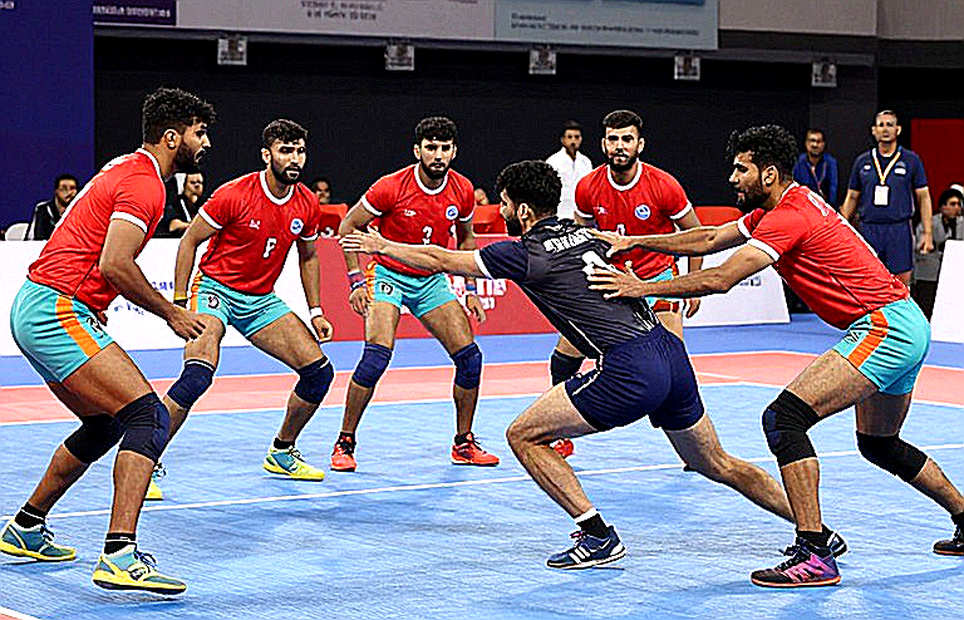
For anyone who has only heard of kabaddi: it is a seven-a-side contact sport played on a 13m × 10m court, in which one player at a time crosses into the opponent's half holding his breath. That attacker is the raider; he has 30 seconds, he must touch at least one defender, and he must return safely. Throughout the raid he must keep chanting "kabaddi, kabaddi" — that is the cant, and if the cant breaks, the raider is out. The defending side stops him collectively; that is a tackle. Deep in the opponent's half there is a line, the bonus line; touching it earns one point, but only if six or more defenders are on the court. When every player on one side has been ruled out, the opponent earns two points and the entire team revives — that is the all out, the engine of kabaddi's rapid swings. After two consecutive empty raids, the third becomes compulsory, and if that also yields nothing the raider himself is out — the do-or-die rule, popularised by Pro Kabaddi and later adopted internationally. A tackle made with three or fewer defenders on court is a two-point super tackle, and a single raid worth three or more points is a super raid.
This architecture matters because most of the 62 matches in Ahmedabad will be decided inside those four or five rules. And one of them — the arithmetic of the draw — is already telling us what shape this tournament is in.
My cant book filled with the words officials used when they meant something else. In 2026, when I talked my way onto the kabaddi beat at a Pune digital desk three weeks before Pro Kabaddi Season 5, I set myself a rule that has not changed: no term appears in my copy that I cannot define in a single sentence. In the statements around this tournament there is one word that is entirely absent, and its absence is the biggest story here: "style".
No official release states whether this championship will be played in standard style or circle style. That is not a small omission. India has two different games wearing the same name. Standard style is the rectangular-court game that underpins Pro Kabaddi, the Asian Games and the rules of the International Kabaddi Federation. Circle style is the circular, mud-court version that carries the rural Punjab circuit, the railway and police teams, and the pre-Independence tradition. Their rules differ, their players differ, and their economies differ.
If the event is IKF-sanctioned — and the statement says the IKF has approved it — then the court will be rectangular, because IKF approval of a circle-style event would be institutionally incoherent. That inference is solid, but it is an inference. And this is my habit: I put the written record above folklore, so until the draw and the rule book are public, I will call it an inference.
Now the arithmetic. Sixty-two matches, 39 men's and 23 women's. That gap is too large to be decoration. Assume both categories use a two-group round-robin plus two semifinals and a final, the most common shape at this level. Split 13 men's teams into groups of seven and six: the round-robin yields 21 and 15, so 36, plus three knockouts, giving exactly 39. It reconciles perfectly. In the women's draw, 23 matches reconcile only if ten teams are split five and five — ten and ten, so 20, plus three knockouts, giving exactly 23. That reconciles perfectly too.
The direct implication is that roughly three of the 13 nations are not sending women's teams. That is the most concrete, quantified news of this entire event, and it is the exact opposite of the speech made on that stage. Where the men's draw contains every member nation, the women's draw has three empty seats. And this in a sport where India's women have won four Asian Games golds.
Here I have to doubt my own argument. The arithmetic fits cleanly, but it is arithmetic, not an announcement. If the organisers are using a different format in the women's category — a single round-robin, or a different count of playoffs — my conclusion collapses. The fact that would have kept the conventional reading alive is this: the full, published group-wise draw. It is not public. So I am writing that three nations are not entering women's teams — and I am also writing down whose piece of paper would prove or disprove it.
Now the second number, which collides with the first. The release says more than 400 players will take part. Divided across 13 countries, that is roughly 31 per nation. A senior kabaddi squad is normally 12 to 14 players. The figure of 31 works only if every country is entering both categories — about 15 men and 15 women each. But then the women's match count should have been far higher than 23. The two numbers cannot both be true unless "400+" includes support staff, coaches and officials, or unless the figure is approximate.
This is where the cant book earns its keep. "More than 400 players" is a sentence any press release can carry and any reporter can print unchecked. I will not print it and move on; I will call it internally inconsistent and pending verification. That is the difference between a beat report and an advertisement.
Look also at the density. Sixty-two matches in nine days is roughly seven a day. That volume does not come out of one court in one hall; it needs multiple courts or very long days. And for teams whose playing budget, sports-science support and recovery protocol look beautiful on paper and absent on the ground, seven matches a day means a rising exposure to soft-tissue injury. Several teams here will be diaspora and developing-nation sides built out of weekend training rather than a domestic league. The medal table will never show this. The physio table will.
Back to the rule layer, because that is where the real margins are made. The bonus line is a gift to the side with strong raiding facing a deep, passive defence. Accumulating one point at a time at low risk is exactly how a powerful raiding unit wears down a weak tackling unit. If a team parks seven defenders behind the line against India's raiders, the bonus line will be touched again and again and the gap will widen without a single dramatic touch.
The do-or-die rule removes the weakest teams' greatest strategic concession — the licence to burn empty raids and eat the clock. That is good for competitive fairness, because it suppresses upsets. But for a showcase event it is commercially expensive, because upsets are the spice that brings in a new audience. The rule book itself is deciding what kind of contests we get, and they lean lopsided.
And the biggest structural advantage of all is that the Indian squad needs no adaptation. The IKF rule set is the one Pro Kabaddi and the Asian Games run on. Indian players grew up with that 30-second clock, that bonus line, that do-or-die. For a diaspora side across the mat, those same rules may be foreign. Standardisation does not make competition easier; it often widens the gap, because the side already thinking in that language plays without translation.
Everything available about India here is about leadership, not performance. Surjeet Singh captains the men, Naveen Kumar is vice-captain. Nidhi Sharma captains the women, Ritu is vice-captain. That is all. No raid points, no tackle points, no successful raid percentage, no squad lists.
This is where I return to my oldest habit: I do not print a name I cannot define in one sentence. "Surjeet Singh" is an extremely common name in Indian kabaddi, and more than one player has carried it — some with a raiding profile, some with a defending one. Inferring a team's style from a captaincy announcement would be a rush.
The name Naveen Kumar is a different story. If this is the "Naveen Express" who plays for Dabang Delhi, then India is not sending a purely developmental squad; it is sending a league-calibre player. That signal matters, because it tells us how seriously the federation is treating the event. But I will call it plausible, not confirmed, until a squad list appears.
In the women's side, "Ritu" creates the same problem. Abbreviated naming is an old habit in Indian sports reporting, and "Ritu" may be the short form of a longer registered name — Ritu Negi, a recent Indian women's captain, for instance. But inference and identification are different things, and that difference is journalism.
What can be read cleanly from the leadership structure is that the men's vice-captain is a raider. That matches the Indian template: build the team around raiding output, especially when the tackling unit opposite is weak. It is not a large finding, but it is an honest one. And honesty requires saying that everything else in the available information is missing.
There is another kind of absence, and it belongs to the women's category. Indian women's kabaddi has won four Asian Games golds and still has no franchise league. That sentence sounds old and is entirely current. Male players became crore-rupee auction lots after July 2026; women kept winning international medals over the same period with no stage to be seen on.
So the women's draw in Ahmedabad is not just a draw. It is the biggest window this year for players who have no domestic league at all. Which is precisely why the number 23 bothers me. If this event is part of the 2030 Commonwealth Games file, the heaviest item in that file will be the one Olympic programme criteria examine most strictly — gender equity, meaning a credible women's discipline. Having two categories is itself a signal, and I do not read it as decoration. But having two categories and having two equally deep categories are different things.
There is one more layer that usually gets skipped. The circle-style circuit — the mud of Punjab and Haryana, the railway and police teams, the village fairs — is where this sport's real players come from. In 2026-21, when the lockdown postponed the season, I drove 1,400 km over five weeks and interviewed 34 circle-style players. Several had gone back on railway and police duty; two were on family farms. That series was called The Unpaid Season, and it taught me something no press release contains: this sport's economy is split in two, and the bridge between the halves is very thin.
Ahmedabad can thicken that bridge or make it more visible. If the 13 squads contain a large number of diaspora players — from Britain, Canada, Australia, South Africa — then this is the moment when Indian coaching methods, quietly rewritten over recent years by Iranian defensive imports, are tested against players who learned the game elsewhere. That is not a small thing. Since 2026 India's real rival has been Iran, not Pakistan, and anyone watching this tournament through an India–Pakistan lens will miss the actual contest.
Jakarta is still fresh. In 2026 I came off the Russia night desk and flew straight to Jakarta, where India lost a group game 23-24 to South Korea and the semifinal 18-27 to Iran. It was the first time India had ever missed the men's Asian Games gold. I stood in the mixed zone at Istora Senayan for 90 minutes, filed at 2 a.m., and read 900 comments before sleeping. Since that night I have kept two habits: no reaction piece the same night, and no final written without reading the heartbreak ledger, which records every Indian collapse since the 2026 Ahmedabad final.
All of this matters because the Ahmedabad tournament is not itself a site of potential upset — it is an event in which the possibility of upset has been designed out by the rules. Do-or-die and the two points from an all out together ensure that weaker teams cannot stay on the scoreboard for long. So I read this as a demonstration rather than a competition.
And that is the reversal I want to write. The obvious story is that kabaddi is going global, 13 countries have arrived, and the road to the 2030 Commonwealth Games is opening. That story is not wrong, but it is incomplete, and in its incomplete form it is misleading. The order on that stage — jersey, song, logo, mascot, and no draw after it — tells us the event's centre of gravity is brand-building, not competition. Announcing captains is a marketing decision; announcing groups is a sporting one. The first happened. The second did not.
This does not make the event bad. It means that if we watch it through a sporting lens we will ask the wrong questions. The right question is not by how many points India wins. The right question is whether, by the semifinals on 30 October, any women's team is left that can genuinely push India — and whether the data to answer that will be made public.
And I will also write the fact that keeps my thesis alive. If the organisers publish the full group-wise draw and it shows that all 13 nations entered women's teams, and the 23-match figure can be explained by a different format, then my arithmetic falls and the event's gender signal proves real. I can live with that. What I cannot live with is repeating a number I have not checked.
The things to watch are plain. First, publication of the group-wise draw — it will settle how many women's teams actually exist. Second, the rule book version — whether the IKF's latest cycle, including video review scope and substitution count, applies. Third, squad lists, because names like Naveen Kumar and Ritu remain inferences until full names and profiles appear. Fourth, court count and the daily schedule — the pressure of seven matches a day lands on someone's hamstring, and that someone will be a diaspora player with no recovery staff.
On the evening of 31 October, when the final whistle goes, I will not be looking at the medal table. I will be looking at what time the women's final is scheduled, how many people are sitting in the hall, and how many teams were still standing seven days earlier to reach that mat. The press box clock keeps ticking after the final whistle. The question is whether the next time Ahmedabad opens a bid file, it will contain a photograph of the women's draw or only a mascot.

संबंधित खिलाड़ी
अनुशंसित
Ahmedabad's First Commonwealth Kabaddi Championship: What the 39-23 Match Split Says Before a Single Raid2026-10-23
First Commonwealth Kabaddi Championship in Ahmedabad: The Arithmetic of 62 Matches and the 2030 File Nobody Is Reading2026-10-23
Read Iran's 34, Not India's Ninth Gold: This Win Came From the Tackle Chain, Not the Raid2026-10-23
First Commonwealth Kabaddi Championship in Ahmedabad: 62 Matches, 13 Nations, and Only 23 Women's Games2026-10-23
Commonwealth Kabaddi Championship: 62 matches, 13 nations, and the 39-vs-23 gap the schedule itself explains2026-10-23
अनुशंसित
Fourteen Became Thirteen in Ahmedabad: What Pakistan's Withdrawal Really Says About the Commonwealth Kabaddi Championship2026-10-23
First Commonwealth Kabaddi Championship in Ahmedabad: The Arithmetic of 62 Matches and the 2030 File Nobody Is Reading2026-10-23
First Commonwealth Kabaddi Championship in Ahmedabad: 62 Matches, 13 Nations, and Only 23 Women's Games2026-10-23
Match 4, and India's First: In Ahmedabad, the Rotation Matters More Than the Scoreline2026-10-24