
Kabaddi Champions League: Expansion to 10 Teams and a Rs 5 Crore Purse, But the Real Story Is PKL's Broadcast Crisis
मुख्य तथ्य: कबड्डी चैंपियंस लीग ने टीमों की संख्या 8 से बढ़ाकर 10 की और प्रति फ्रेंचाइजी 5 करोड़ रुपये का नीलामी पर्स तय किया; सर्वाधिक बोली आयन लोचब पर 17.4 लाख रुपये; सुनील मलिक 10 लाख में खरीदे गए; ट्रायल में करीब 6,400 पंजीकरण, 300 से अधिक नीलामी पूल में; दसों फ्रेंचाइजी हरियाणा के शहरों की (भिवानी, रोहतक, करनाल, गुरुग्राम, सोनीपत, पानीपत, फरीदाबाद, हिसार, झज्जर, कुरुक्षेत्र)। संदर्भ: PKL का 13वां सत्र संभवतः जून-जुलाई 2027 तक खिसका, क्योंकि नया ब्रॉडकास्ट साझेदार नहीं मिला — यह इस खबर का सबसे महत्वपूर्ण संरचनात्मक संकेत है। महत्वपूर्ण बारीकी: 5 करोड़ पुरस्कार राशि नहीं, बल्कि प्रति टीम टीम-निर्माण बजट है (लगभग 6 लाख अमेरिकी डॉलर), जो PKL के सामान्य खर्च का एक अंश है; रिपोर्ट में यह भी स्पष्ट नहीं कि आंकड़ा प्रति टीम है या पूरी लीग का। अनिश्चितताएं: लीग का संचालक और मान्यता (AKFI/IKF) अपुष्ट; खिलाड़ी प्रदर्शन आंकड़े अनुपलब्ध; प्रसारण, स्पॉन्सरशिप, दर्शक या राजस्व का कोई आंकड़ा नहीं; 'भारत के एशियाई खेलों के कप्तान' के रूप में सुनील मलिक का पदनाम सत्यापन योग्य नहीं। निष्कर्ष: यह एक हरियाणा-केंद्रित अर्ध-पेशेवर विकास लीग का विस्तार है, जो PKL के ठहराव के दौरान अवसरवादी खाली जगह भरने की कोशिश के रूप में पढ़ा जाना चाहिए — न कि व्यावसायिक ताकत के सबूत के रूप में।
The Kabaddi Champions League (KCL) has announced that it will expand from 8 to 10 teams next season and set an auction purse of Rs 5 crore per franchise. It has also revealed the highest-priced player from its first player auction — Ayan Lochab, bought for Rs 17.4 lakh. On the surface this is straightforwardly good news for kabaddi: more teams, more places for players, a bigger budget.
But buried in the fourth paragraph of the same report is a piece of information that matters far more to the entire Indian kabaddi ecosystem than the expansion itself: the Pro Kabaddi League's next season has reportedly been pushed to June-July 2027, and the stated reason is the absence of a new broadcast (media rights) partner.
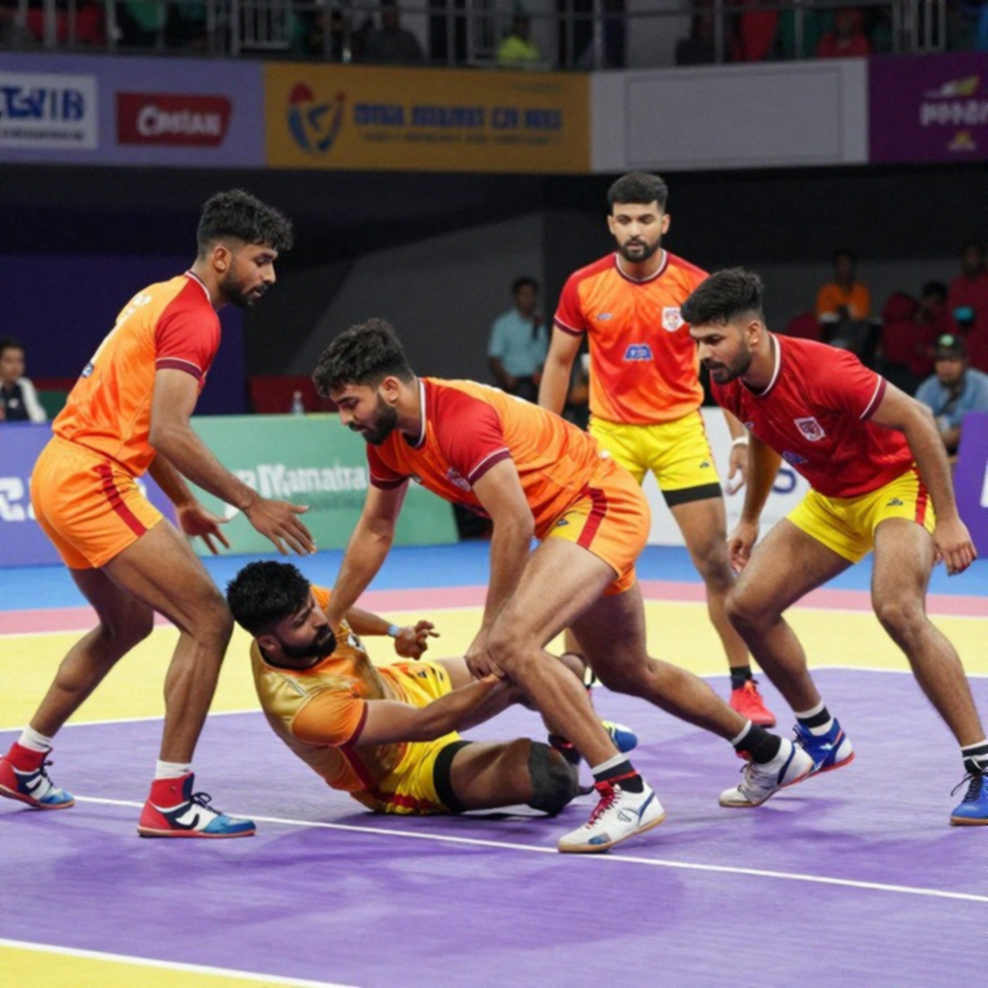
In other words, at the precise moment the country's flagship professional kabaddi league is wrestling with a media-rights crisis, a regional league is announcing expansion. The question is whether this expansion is evidence of strength, or an attempt to occupy the vacuum created by PKL's stall. The available data points toward the latter.
The expansion: 8 to 10 teams
The organisers have decided to add two teams, taking the total to 10. The move is being made in Haryana, kabaddi's traditional heartland, and is being presented as the league strengthening its presence. According to the organisers, franchises will have greater scope and freedom to assemble their squads in the new season.
But team count alone is not a measure of expansion quality. Key questions remain: what will the total match calendar look like? Will it be a full round-robin? Is the season length fixed or will it grow with the teams? If the season length stays the same while teams increase, per-team fixtures either shrink or get congested — and in either case, questions arise about per-match quality and player workload. The report gives no format details.
It is equally unclear whether the league will be played under Standard Style rules or Circle Style, and what the foreign-player quota will be. These are not merely rulebook details — they determine what product the Rs 5 crore purse is actually buying. If no overseas players are permitted and squads are large, this is a fundamentally different, developmental-tier product from PKL.
Geography: national name, Haryana footprint
The ten franchise cities are Bhiwani, Rohtak, Karnal, Gurugram, Sonipat, Panipat, Faridabad, Hisar, Jhajjar and Kurukshetra. That list is itself the biggest revelation: all ten are in Haryana. The sense of national or international significance that the name Champions League conveys does not match this geography.
This is not a criticism, but a clarification. Haryana is India's traditional kabaddi and wrestling heartland — players raised in village akhadas have fed the national team for decades. A regional league emerging in such a state is logical. But calling it a national league would be misleading, because it has no meaningful presence in other strong kabaddi centres such as Maharashtra, Punjab, Tamil Nadu or Telangana. The stage is named big; the scale is small.
The auction purse: what Rs 5 crore actually means
The most-quoted figure in the report is the Rs 5 crore auction purse per franchise. First, it must be understood that this is not prize money. It is the total budget with which a team buys players at auction — the entire squad must be built within it.
Now put it in context. Rs 5 crore is roughly US$600,000 at prevailing rates. A single PKL franchise's typical auction outlay has historically been several multiples higher. Moreover, top PKL star raiders alone have commanded upwards of Rs 1 crore. This comparison is a direct signal that KCL's Rs 5 crore purse is a fraction of a PKL budget, not a competitor to it.
There is also a serious ambiguity here. The report does not specify whether the Rs 5 crore is per team or for the entire league. If it were a league-wide figure, dividing it across 10 teams would leave only Rs 50 lakh each — which barely squares even with the Rs 17.4 lakh top bid. However, the phrase about franchises having greater scope to assemble their squads makes it near-certain that the figure is per franchise. Even so, for any financial analysis, this ambiguity is a major obstacle and should be recorded as a signal: even the report's central data point is left undefined.
The player market: a Rs 17.4 lakh top bid and one big question
The highest bid at auction went to Ayan Lochab — Rs 17.4 lakh, making him the league's most expensive player. But there is no data available on his play: no raid points, no tackle points, no success rate, no positional profile. We cannot say how good a player he is; we can only say that the market priced him highest.
The most interesting data point is Sunil Malik. The report describes him as India's Asian Games captain and he was bought for just Rs 10 lakh. This is an internal inconsistency that cannot be ignored. If a player really is India's Asian Games captain, it is unusual for his price to sit in the lowest bracket — particularly when the top bid is only Rs 17.4 lakh.
There are three possible explanations, and all should be kept open. First, the Asian Games captain label may be stale or decorative — he may have captained a past edition, or a different age group or format. Second, the designation may belong to Circle Style or another variant rather than standard international kabaddi. Third, it may be a reporting error. None can be settled without verification against official rosters.
What is clear is that absolute player prices in this league are modest. A top bid of Rs 17.4 lakh and a captain-level bid of Rs 10 lakh suggest most players are part-time or semi-professional, relying on other income. That fits Haryana's sporting economy, where government jobs and sports quotas have long underpinned athletes' livelihoods.
From trials to auction: 6,400 down to 300
The league's most concrete achievement is its talent-identification process. Around 6,400 players registered for trials, of whom more than 300 made the auction pool. That is genuinely impressive — over six thousand players in a single state turning up to try their luck.
But there is a risk of misreading this number. 6,400 registrations are not an indicator of the league's popularity but of rural young people's shortage of sporting opportunity. When professional platforms are scarce and a government job runs through sport, a crowded trial is natural. This is a supply-side number (players' hope), not a demand-side one (audience interest). Conflating the two is the most common analytical error.
One more point: 300 selected out of 6,400 is roughly 4.7 percent. That is a tough cut, but the question is what the selection was based on — was there a standard test, criteria, or data-driven scouting? The report is silent.
The real story: PKL's broadcast crisis
Back, now, to the most important piece of information in the entire report. According to it, PKL's 13th season may slip to June-July 2027, and the reason is a gap in broadcast rights. In plain terms: the league's previous broadcast partner has gone and a new one has not yet been agreed.
For Indian kabaddi this is not merely a calendar problem. Since PKL launched in 2026, the sport's entire professional structure has rested on television and sponsorship. Kabaddi's format is short, matches are fast, and it is an ideal television product — but a large share of its revenue comes from broadcast rights and sponsorship. If there is no broadcast partner at all, three things come under pressure at once: player salaries, team budgets and sponsor confidence.
The comparison is direct. PKL is Indian kabaddi's commercial anchor. KCL is a regional, semi-professional league. If the anchor itself pauses for a season, no regional league can fill that void — not on audience scale, not on money. For KCL this is an opportunity (idle players will be available), but for the sport it is a crisis.
It is also worth noting that the report names no new PKL broadcast partner, no timeline, and no negotiating detail. It uses only the word uncertainty. For a professional analyst, pushing a season back a full year signals protracted and difficult rights negotiations — plausibly with a valuation downgrade.
The commercial side: what is missing
What the KCL report does not contain matters more than what it does. No broadcast deal, no sponsorship announcement, no attendance figures, no ticket revenue, no team-level income disclosure. The expansion is being announced at a time when not a single revenue-side number is public.
This is no small gap. Any league's case for expansion rests on three things: audience demand, broadcast/sponsorship income, and depth of player quality. Not one of the three has data behind it. Adding two teams is not an achievement in itself — it also adds cost: more matches, more hosting expense, more player wages.
Run a simple calculation. If a Rs 5 crore purse has to build a squad of 15 to 20 players, the average salary works out to Rs 25-33 lakh per player. But the top bid is only Rs 17.4 lakh. That implies either squads are very large (30-40 players), or the purse is not fully spent. Either way, the Rs 5 crore figure looks more like a declared ceiling than actual spending. This is an estimate and should be read cautiously, but it shows the numbers do not fully reconcile.
It is also possible that the purse money is not coming from league revenue but from franchise owners' or a promoter's pockets. Many early-stage non-cricket leagues in India have run this way — the first two or three seasons funded by owners, and when broadcast income failed to arrive, the league shut or shrank.
Governance: the largest unanswered question
The biggest uncertainty around this league is not sporting but administrative. The report nowhere states who organises the league, who has sanctioned it, or whether it has recognition from the Amateur Kabaddi Federation of India (AKFI) or the International Kabaddi Federation (IKF).
This matters because unsanctioned leagues in India create risk for players. If a player features in a league the national federation does not recognise, questions can arise over national-team selection or future competition eligibility. That is a particular concern for players who carry claims of international experience.
Likewise, there is no mention of player contract terms, minimum-salary guarantees, injury protection, anti-doping oversight or refereeing standards. A league expanding rapidly without disclosing its institutional framework should be viewed with caution. This does not mean something is wrong — only that transparency is zero, and therefore trust must start from zero.
Risks: four main points
First, a confusion of scale. The Champions League name conveys national or international significance, while all ten franchises are in Haryana. Audiences, sponsors and media can all form inflated expectations.
Second, player quality is unverified. No performance data is given. The Rs 17.4 lakh top bid is a market signal, not a quality signal.
Third, the financial base is absent. No broadcast, sponsor, ticket or revenue figures.
Fourth and largest, ecosystem risk. The PKL broadcast crisis will not stay confined to PKL. If PKL sits out a season, the pipeline from rural trials to professional league that has existed since 2026 weakens at both its first and second rungs. Players get fewer places to play, less exposure, and downward pressure on wages. A regional league cannot bridge that gap.
Haryana's cultural context
Haryana's position in India is akin to that of a province that supplies a disproportionate share of Olympic talent. Village akhadas — mud training pits — are the centre of its sporting culture. A player emerging from there moves to state level, then national level, then a government job. The village boy turned contracted athlete is a genuinely inspiring story, and that social energy sits at the root of the 6,400 trial registrations.
But there is a risk in using that story as advertising. The question is whether the league delivers on the promise. A top price of Rs 17.4 lakh and a captain-level price of Rs 10 lakh suggest limited financial reward. The league is running on talent supply, not audience demand. That is the normal pattern for any new league's early phase — and also its most fragile.
Conclusion: the expansion is real, but the signal is elsewhere
There are two stories at two different levels in this report. The first, smaller one: a Haryana-centric semi-professional kabaddi league is adding two teams and offering a Rs 5 crore purse. That is true, it is happening, and it creates real opportunity for players in the region — even if modest.
The second, larger one: Indian kabaddi's commercial centre, PKL, is likely postponing its next season into 2027 for want of broadcast rights, with no replacement partner named. That is not a scheduling story; it is a structural event affecting the sport's entire revenue chain.
The bigger economic truth is that when the flagship league stalls, a smaller league's expansion is not necessarily proof of strength. Sometimes it is an attempt to fill space. In KCL's case the signals point that way: modest budgets in the player market, a modest top bid, no broadcast or sponsorship data, and an undefined governance base. Expansion is being announced regardless.
This does not mean the league should be stopped. It means the gap between claims and data should be recognised. Do not conclude from more teams and a bigger purse that the league is getting stronger. There are three real tests: has a broadcast deal been signed, have sponsors come in, and have audiences turned up at venues or on screens. None has an answer yet.
For those who follow kabaddi seriously, the signals worth tracking are clear: PKL's new media-rights deal (and official confirmation of Season 13), KCL's sanctioning status with AKFI/IKF, any KCL broadcast deal, and Season 2 attendance and revenue figures. Any one of these will change the picture. Until then, this expansion is better read as a possibility than as momentum.