
होमAsian CricketHK Sixes 2026: One Last Ball Seals the Fate as Six-Time Champions Pakistan Crash Out in Group Stage
HK Sixes 2026: One Last Ball Seals the Fate as Six-Time Champions Pakistan Crash Out in Group Stage
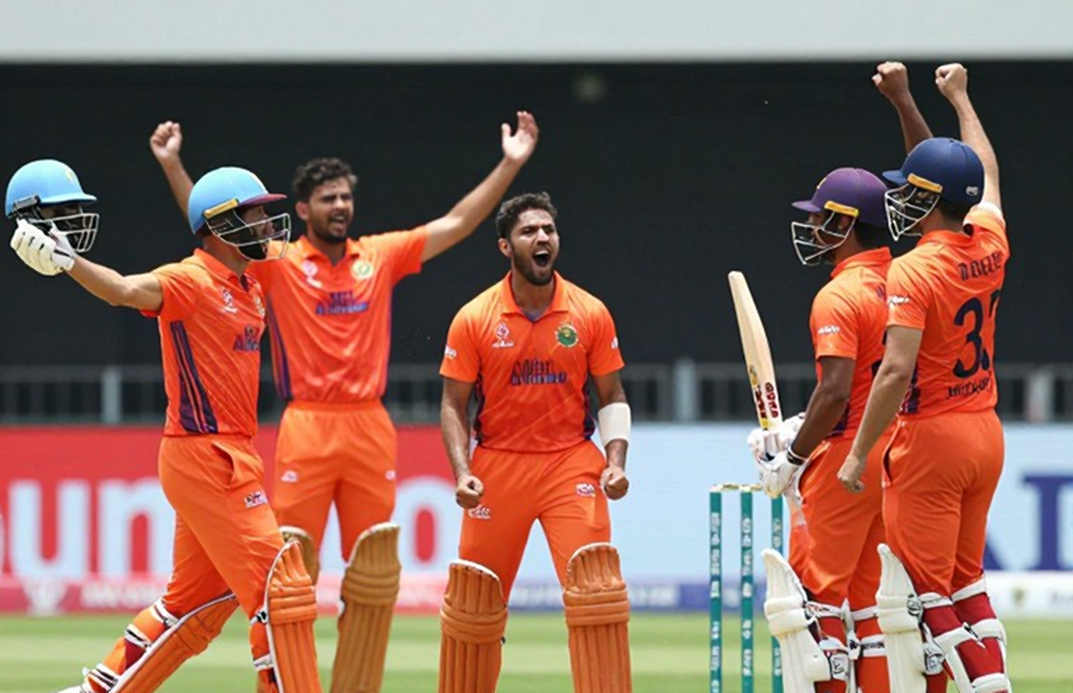
HK सिक्सेज़ 2026 में छह बार की चैंपियन और पिछले संस्करण की विजेता पाकिस्तान ग्रुप C से कप सेमीफ़ाइनल के लिए क्वालिफ़ाई नहीं कर सकी। UAE ने दोनों मैच जीतकर ग्रुप में शीर्ष स्थान हासिल किया, जबकि पाकिस्तान एक जीत और एक हार के साथ दूसरे स्थान पर रहा। निर्णायक मोड़ पहला मैच था, जिसमें पाकिस्तान ने UAE के ख़िलाफ़ 106/3 बनाया (अब्बास आफ़रीदी 53, ख्वाजा नफ़ाय 41) लेकिन UAE ने आख़िरी गेंद पर लक्ष्य हासिल करते हुए एक विकेट से जीत दर्ज की। पाकिस्तान ने भारत को 3.5 ओवर में 91/2 बनाकर हराया था, जबकि UAE ने भारत के 95 के जवाब में चार ओवर में बिना विकेट 96 रन बनाए। अब पाकिस्तान शनिवार सुबह 11:15 PKT (हांगकांग समय 14:15) पर प्लेट सेमीफ़ाइनल में मेज़बान हांगकांग से खेलेगा। ध्यान दें: प्रारूप में 31 रन पर अनिवार्य रिटायरमेंट का नियम लागू है, जिसके कारण व्यक्तिगत स्कोर टीम टोटल के करीब पहुँच जाते हैं।
Pakistan's campaign at Hong Kong Sixes 2026 ended at the group stage, before it could reach the Cup semi-finals. The six-time champions and defending title-holders finished second in Group C with one win and one loss. Under the tournament's format, only the group winner advances to the Cup semi-finals, and that spot went to the UAE, which won both of its matches. Pakistan will now play in the Plate semi-finals, where they face hosts Hong Kong.
The most striking element of this story is the contradiction buried inside it. Pakistan hammered India in the same group — India made 88/5 and Pakistan chased it down at 91/2 in 3.5 overs, with seven balls to spare and complete control of the chase. A team that produced that performance in its second match ended up eliminated from the tournament.
The root of it lies in the first day's match. In their Group C opener, Pakistan posted 106/3 against the UAE, a strong total in a six-over game. Captain Abbas Afridi made 53 and Khawaja Nafay made 41. But the UAE fought to the last ball and got home — a one-wicket victory. In a six-a-side format, "a one-wicket win" means the chasing side got there having lost five wickets. That is the match that decided the direction of Pakistan's entire tournament.
One technical point needs explaining here, because without it the scorecard looks absurd. Under Hong Kong Sixes rules, any batter must retire upon reaching 31 runs, but may return later. That is why Afridi's 53 and Nafay's 41 sit perfectly alongside a team total of 106 — both retired and came back to bat again. A reader unfamiliar with the rule will find the scorecard nonsensical. The original coverage did not explain it anywhere, and that was its single biggest information gap.
In their second match, Pakistan dismantled India in the way the UAE had refused to let them do in the first. India folded for 88/5, and Pakistan's batters went on the attack from the start. Chasing a target in 3.5 overs means a scoring rate of roughly 24 an over — extraordinary even in the six-over format.
But the most impressive performance in the group belonged to the UAE, and it did not get the space in the reporting that it deserved. Chasing India's 95, the UAE reached 96 in four overs without losing a single wicket — a rate of 24 an over, unbeaten. That is a story in itself. Yet not a single UAE player was named anywhere in the coverage. For a team that won both matches, topped its group and never lost, to have no named individual at all is a serious imbalance in the reporting. Going further — framing the UAE's wins merely as the "cause" of Pakistan's exit diminishes what that team actually did.
Group C's table was clear: the UAE on top with two wins, Pakistan second with one win and one loss, India third having lost both. That also means net run rate played no role at all — the UAE winning both matches left no room for dispute. It was the UAE's win over India that pushed Pakistan down to second, meaning the results arrived in exactly the order the matches were scheduled: first the UAE beat Pakistan, then Pakistan beat India, then the UAE beat India. All three outcomes lined up in a straight line.
The tournament's structure has three tiers — Cup, Plate and Bowl. Group winners go to the Cup semi-finals; the rest move into the Plate. Which is why "Pakistan are out" does not mean their tournament is over; they can still win the Plate. That nuance matters, and the original report handled it carefully so that readers would not be misled.
Now the point that appeared nowhere in the original coverage and matters most: Pakistan's entire tournament turned on a single ball. The UAE match finished on the last delivery. Had that one ball been prevented from scoring, Pakistan would have been 2-0, top of the group, and in the Cup semi-finals. This is not a figure of speech — it is a structural property of the format.
In Hong Kong Sixes, teams have six players, innings last six overs, and each bowler can send down a maximum of one over. The direct consequence is that teams have very little room to make up a gap through sheer quality. A single over can yield 20-plus runs or flip the course of a match. In that setting, phrases like "dominant victory" and "heavy defeat" lose much of their explanatory power — the real difference between thrashing India and losing to the UAE could be as little as an over or two of fluctuation. The format is built for entertainment, not for stable conclusions; that is both its strength and its limit.
This is why the information value of "six-time champions are out" is lower in this format than the equivalent sentence would be in 50-over or T20 cricket. None of which means it is not news — it is — but drawing the conclusion that "Pakistan fell short" from it would be wrong. This is cricket's most volatile format, and that volatility is the central character of this story.
One more question attaches to all this, and it went unanswered: is the UAE genuinely strong enough to score 96 without loss in four overs? Or was that an extraordinary coincidence within six-over cricket? Leaving that unanswered makes any assessment of Pakistan's performance incomplete — and leaves the UAE's true strength unknown.
The second big question: what kind of team did Pakistan send? Abbas Afridi and Khawaja Nafay are both current or emerging international players — if this was an experimental, youthful or rotation side, then the whole "failed to defend the title" framing is wrong. That is an inference, not evidence; without official confirmation it should not be written as a conclusion. But it is a question the coverage should have asked.
The schedule ahead is clear. Pakistan face Hong Kong in the Plate semi-final on Saturday. By Pakistan Standard Time (PKT, UTC+5), the match starts at 11:15 am, which is 2:15 pm local time in Hong Kong (HKT, UTC+8). For the hosts, here is a chance to knock a former champion out of the Plate too; for Pakistan, it is the last route to ending the tournament with something to show. Note that this shelf life is short — once Saturday's match begins, "Pakistan will play in the Plate" becomes a historical statement.
The rules you need to understand: six players per side and six overs per innings; each bowler a maximum of one over; a batter must retire upon reaching 31 but may return; an innings ends at five wickets down, because the last batter cannot bat alone; group winners go to the Cup semi-finals, with the rest going into the Plate and Bowl. Hold those rules in mind and there is no contradiction between Afridi's 53 and a team total of 106/3.
What remains unanswered: the names and composition of the UAE side; who won the toss; who bowled the final over against the UAE; whether Pakistan fielded a full-strength or experimental team; and official confirmation of the "six-time champions" claim — the one assertion that could overturn the entire framing. Any one of these would meaningfully improve the report. A report that states the result and skips these questions never gets past the scoreline.
The conclusion is clear. Pakistan's exit is a fact, and so is its cause — a one-wicket defeat to the UAE off the final ball. But understanding that fact requires knowing how much weight a single ball and a single over carry in six-over cricket. The UAE won both their matches, topped the group and earned their place on merit — burying their story beneath Pakistan's failure would not do this tournament justice. Pakistan have a route back through the Plate; the UAE have a chance to prove their run was no accident.
संबंधित खिलाड़ी
अनुशंसित
Five Points and the Door at Eight: Haris Rauf's Ledger Behind Lahore's One-Wicket Win2026-10-29
Abhishek Sharma Is World No. 1, but the Real Story Is the 14 Points Nobody Headlined2026-10-29
Abhishek's 897 and Farhan's 883: the 14-point gap is a bigger story than Jansen's double crown2026-10-29
The Empty Feed: Who India's Cricket Information Calendar Is Actually Built For2026-10-26
Two Days of Warm-Up, Two Tests at Stake: Bangladesh's Real Preparation Story Is Hidden in the BCB XI Selection2026-10-23
अनुशंसित
England U19: 18 Names, Four Routes — the Rawalpindi Tour Is Really a Load-Management Document2026-10-27
Seven Matches, Three Teams, One Press Release: What PCB's Women's Super-3 Leaves Unsaid2026-10-27
The Empty Cell, the Crowded Market: Where Cricket's Story Goes Missing2026-10-30
Six Overs on TikTok: Who Pays for Cricket’s New Rights Tier?2026-10-23
EDF's Bank Account Approved, Its Numbers Missing: Auditing a Ten-Month Gap2026-10-30