
Ten Millimetres of Truth: Russell's COTA Surface Demand and the Data Nobody Showed
**मुख्य उत्तर:** जॉर्ज रसेल ने कोटा (COTA) की पुरानी सतह पर एफ1 ट्रैक के लिए हर दो साल में रीसर्फेसिंग का मानक बनाने की मांग की, क्योंकि लगभग 10 मिलीमीटर राइड हाइट पर चलने वाली ग्राउंड-इफेक्ट कारें हर गड्ढे को लगभग बिना अवशोषण के सीधे चेसिस तक पहुंचाती हैं। **मुख्य तथ्य:** - रसेल के अनुसार स्ट्रेट के आखिर में मर्सिडीज की राइड हाइट लगभग 10 मिलीमीटर रह जाती है। - 2022 में रिम 13 इंच से 18 इंच हुआ, जिससे टायर साइडवॉल की ऊंचाई लगभग 39 प्रतिशत घट गई। - कोटा का डामर 2012 में बिछा था और अब तेरह वर्ष पुराना है। - 22 अक्टूबर 2023 को ऑस्टिन में लुईस हैमिल्टन और शार्ल लेक्लेर प्लैंक वियर के कारण डिस्क्वालिफाई हुए थे। - रसेल ने कहा कि नए मर्सिडीज पार्ट्स को अपेक्षा से बड़ा सेट-अप एडजस्टमेंट चाहिए। **स्रोत:** जॉर्ज रसेल की कोटा प्री-इवेंट प्रेस टिप्पणी (17–19 अक्टूबर 2025, यूनाइटेड स्टेट्स ग्रां प्री); FIA स्टीवर्ड्स निर्णय, 22 अक्टूबर 2023। **संबंधित प्रश्नोत्तर:** प्रश्न: रसेल ने रीसर्फेसिंग का मानक क्यों मांगा? उत्तर: क्योंकि सतह की असमानता अब सीधे डाउनफोर्स और प्लैंक वियर को प्रभावित करती है, जिससे यह सेफ्टी और प्रदर्शन दोनों का मुद्दा बन गई है। प्रश्न: 18 इंच टायर इस समस्या से कैसे जुड़े हैं? उत्तर: पतली साइडवॉल ने टायर की कुशनिंग क्षमता घटा दी, जिससे सड़क के झटके सस्पेंशन और चेसिस तक अधिक तीव्रता से पहुंचते हैं। प्रश्न: कोटा में सबसे बड़ा जोखिम क्या है? उत्तर: प्लैंक वियर की सीमा से अधिक घिसाव के कारण रेस के बाद डिस्क्वालिफिकेशन, जैसा 22 अक्टूबर 2023 को हुआ था।
George Russell picked up the microphone in the Austin paddock and converted an engineering complaint into a policy proposal. The question was not about tyre compounds, not about brake ducts, and certainly not about undercut strategy. The question was about the top layer of the road. COTA's 5.5-kilometre ribbon of asphalt, laid in 2026, now carrying thirteen years of racing weekends, MotoGP maintenance windows and Texas heat.
Russell supplied one number, and that number is the hinge of the entire argument: at the end of the straight, the car is running at roughly ten millimetres of ride height. Ten millimetres. Slightly more than the thickness of a coin. When a fifteen-to-twenty millimetre bump arrives under that platform, it is not a comfort issue — it is a physics event, and the invoice is paid by three parties at once: the driver's spine, the car's floor, and the team's plank-wear margin.
Before the first sentence, I build the model. Three inputs: ride height, tyre sidewall depth, and the amplitude of surface irregularity. Two outputs: vertical load transmitted into the chassis, and the probability of transient underfloor stall. Everything else is commentary.
Context: a thirteen-year-old surface, a three-year-old regulation
The complaint is not new. Max Verstappen put it in colour this weekend — that racing at this track leaves you needing a new spine, that drivers end up almost like RoboCop. That is hyperbole, but hyperbole is usually born from a measurement. Russell supplied the measurement Verstappen's language did not contain: the ten-millimetre ride height, and tyre construction.
Read the two statements together and a pattern emerges. Verstappen supplies the hyperbole; Russell supplies the engineering explanation that legitimises it. This is editorial architecture, not coincidence. One driver's grievance borrows credibility from another driver's technical vocabulary, and the reader is left believing the story is about comfort. It is not.
There is a second register the article never labels. Russell is not only a Mercedes driver; he is a director of the Grand Prix Drivers' Association. When a GPDA director says tracks should be resurfaced every two years, that is not a driver grumbling — it is a safety-advocacy document delivered via press conference. Because that register goes unlabelled, the story's actual weight is flattened.
Monaco is invoked as corroboration — a red flag for surface inspection this season, Lance Stroll and Charles Leclerc both blaming their cars, and "many" linking the crashes to damaged asphalt. The corroboration is weak, and I will return to it.
Core: where the spring chain broke
The technical core here is not aerodynamics. It is a vertical compliance deficit. A racing car absorbs impacts through four layers: the tyre sidewall, the suspension spring and damper, the stiffness of the chassis itself, and the seat and driver. The 2026 regulations attacked the first layer directly.
The arithmetic is simple, and I do it myself because no team has published it. Total rolling circumference was held roughly constant across 2026 so that gearing and speed-sensor calibration would not have to change. Rim diameter moved from 13 inches (about 330 mm) to 18 inches (about 457 mm). Sidewall height on each side therefore fell from roughly 165 mm to roughly 101 mm. That is about 64 millimetres of rubber cushioning removed — a reduction of roughly 39 per cent.
Russell called it "effective suspension in the tyre". The language is loose; the physics holds. A sidewall is a compliant spring with hysteretic energy dissipation — it absorbs energy and releases part of it over a longer interval. It is not a tuned damper, but it cuts the peak amplitude of an impact substantially. A 39 per cent reduction means the same bump now reaches the suspension at close to the size it had on the road surface.
What ten millimetres actually means
The ten-millimetre figure is not static ground clearance. Based on my years of watching races, when a driver says "at the end of the straight" he is describing terminal velocity — DRS open, suspension fully compressed under aero load, floor at its closest to the ground. That platform state is the most stall-sensitive the underfloor ever gets.
Which means COTA's bumps do not merely inconvenience the driver. They steal downforce mid-straight. A transient underfloor stall means an abrupt balance shift, which lightens the rear exactly as the car enters a braking zone at 300 km/h. This is not a comfort argument. It is a predictability argument, and predictability is the thing drivers pay the highest price for.
This is where two changes compound. In one regulation cycle, 18-inch low-profile tyres arrived alongside ground-effect floors that force teams to run stiff springs and extremely low platforms to keep the underfloor working. Both ends of the spring chain were cut at once: the tyre end thinned, the suspension end stiffened, because the floor needs a stable platform to stay sealed.
Which is why Russell's most important line is not the one that travelled. It is this: "not ideal, but there is not much that can be done." That is not a call to action. It is an admission that this generation's vertical stiffness is baked into the regulation set and cannot be fixed inside the cycle.
The three-way compromise, and the plank bill
Every team arriving at COTA negotiates a triangle. Ride height high enough to survive bumps and plank wear; low enough to keep the floor working; suspension stiff enough to keep the aero platform stable. Choosing one costs the other two. This is not a moral choice, it is a budget constraint.
Part of that budget is settled after the race. On 22 October 2026 at Austin, Lewis Hamilton and Charles Leclerc were both disqualified in post-race scrutineering for excessive plank wear — an FIA stewards' decision, not a rumour. The lesson is unambiguous: a car forced low to make a floor work at a bumpy circuit is a car sitting on the plank tolerance limit. The risk does not materialise on track; it materialises on a metal gauge after parc fermé.
One thing teams never say loudly: surface quality is now a competitive variable, not a facility. A car with a wide set-up window and better bump compliance is structurally advantaged at a venue like COTA. A narrow-window, low-riding concept has to abandon its own design. The track surface has quietly become a performance filter, and no technical directive can fix a filter.
Who pays for the surface
This is where the story leaves safety and enters a balance sheet. COTA is one of the few circuits on the calendar built and operated with private capital rather than government or sovereign money. That connects to the economics I learned sitting in the marketing and sponsorship chair at Force India in 2026: in F1, the question "who wants it" always loses to the question "who pays for it".
No promoter publishes a full-circuit resurfacing line item. From comparable European repaving projects my estimate is 8 to 15 million dollars, and I will call it an estimate — with an error bar, not decimal places. COTA's surface also serves MotoGP and NASCAR, whose requirements differ from F1's. Three series, one piece of asphalt, and the compromise is always paid by one of them. Partial resurfacing between Turns 2 and 10 was carried out for MotoGP in 2026 — patchwork maintenance, not a full-layer replacement.
So read Russell's "repave every two years" as policy, not engineering. It is a demand whose bill lands on the promoter, and the promoter's bill returns through sanctioning fees and ticket prices. The Indian Grand Prix at Buddh died of exactly this arithmetic — not of empty stands, but of Jaypee's loan book. Whenever someone proposes raising a surface standard, the next question must be which balance sheet pays, and how many years its owner can carry it.
The Mercedes upgrade: the real scoop is in the last paragraph
Now the sentence that matters most competitively in the entire article, and the one buried deepest. Russell said the new parts require "a bigger set-up adjustment than we first anticipated".
That phrasing is a paddock marker for a correlation gap. When a package does not behave on track as the wind tunnel and CFD model predicted, the driver's language is exactly this. It implies the operating window is narrow, or offset from the baseline.
Now place it at this venue. A bumpy circuit demands ride-height compromise, and every ride-height change moves the aero platform away from the map the upgrade was validated on. If correlation is already marginal, COTA amplifies the error rather than reducing it.
And the 17–19 October 2026 Austin weekend ran a Sprint format — one free practice session for set-up. A package that, by the driver's own admission, needs more adjustment than expected is structurally being tested in the worst possible environment. The technical problem becomes a sporting one: a mis-set-up car pays in a Sprint and a Grand Prix, not just one qualifying hour.
On top of that sits the cost cap. An upgrade introduced in the final third of a regulation cycle is spent on a car whose concepts carry almost zero value into the next set. The spend buys short-term points only. If the same package also demands unexpected set-up labour, the return is doubly poor.
Methodology note: the 10 mm ride height figure is driver-stated, not FIA-measured. The 165 mm to 101 mm sidewall calculation is my own, resting on rim diameter and constant rolling circumference; actual sidewall profiles are manufacturer-specific. The 8–15 million dollar resurfacing estimate is drawn from comparable projects, not from a promoter's audit. Every number has a source, and every source has a bias.
Contrarian: Russell's own line weakens his demand
Here is what the debate has said least. If the problem is the surface, the fix is resurfacing. But Russell himself said there is not much that can be done about the car's vertical stiffness. Both statements cannot be true if you accept that the root cause is the surface. The root cause is the regulation set; the surface is merely where that cause becomes visible.
This is the classic correlation-causation error. COTA was bumpy before 2026 as well. Cars raced on the 2026 surface in 2026 and nobody talked about new spines, because sidewalls were thicker and floors did not have to sit so low. What changed was not the road. What changed was the car.
The Monaco corroboration is weak too. Stroll and Leclerc blamed their cars — normal driver behaviour, not data. And "many linked" is unattributed consensus, which is paddock atmosphere, not evidence. Russell's argument would be stronger without it.
There is also a journalistic inconsistency worth recording. The most competitively significant sentence in the piece — the upgrade's set-up adjustment — sits in the final paragraph, under a safety narrative at the top. That mismatch between news value and news placement is an editorial choice, and it is a choice made against the reader.
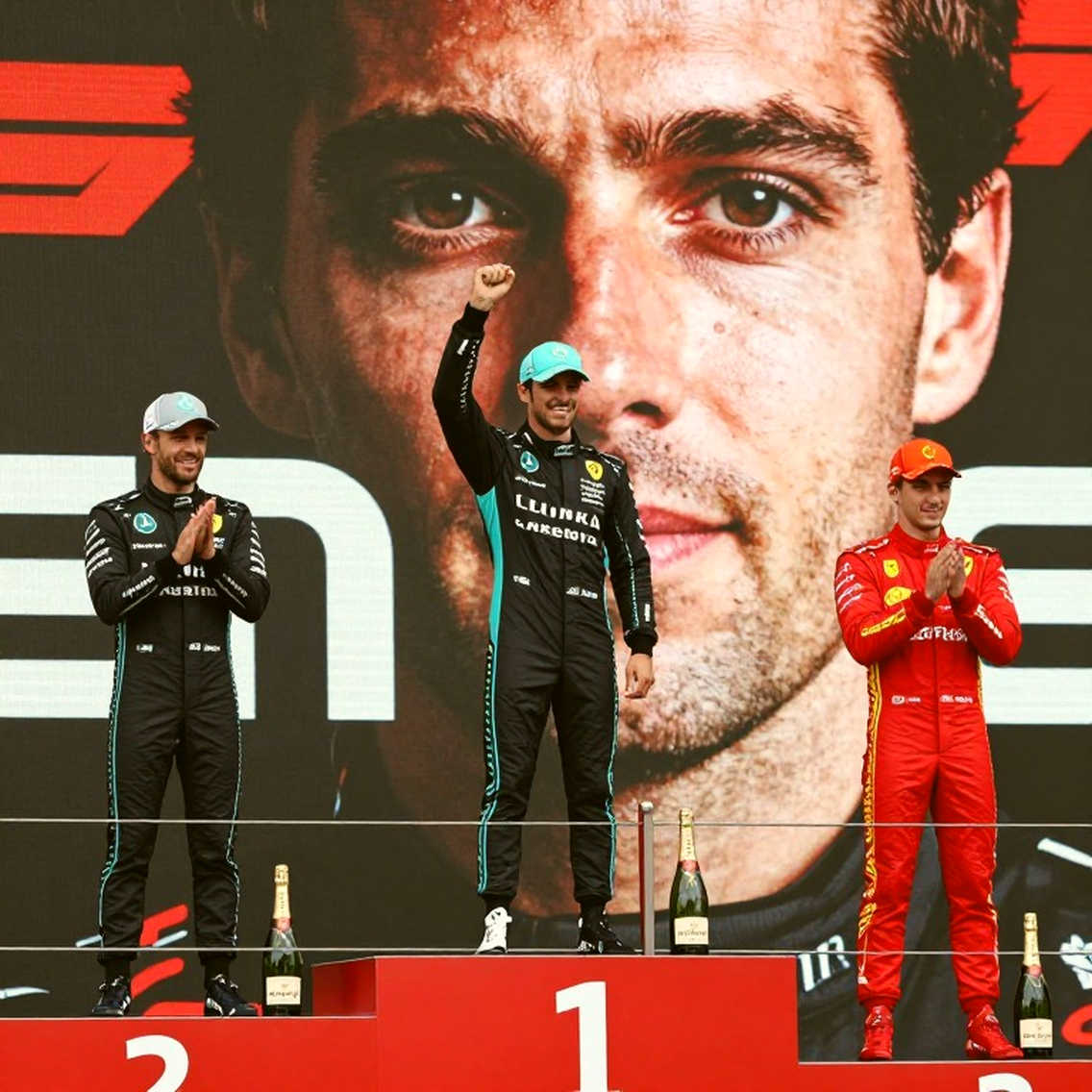
Data-integrity note (public)
The spreadsheet knew before I did, and this time it issued a warning. The supplied material contains a claim that Russell sits second in the Drivers' Championship while 102 points behind his Mercedes team-mate Kimi Antonelli. The arithmetic is internally consistent. It does not reconcile with the known 2026 competitive order, and if true it would be one of the decade's biggest stories — not a throwaway line in a track-surface article. Two readings are possible: an attribution error in the source, or a season I cannot verify from this material. I therefore suspend every championship-derived conclusion, and I state my condition in advance: if verified standings falsify the claim, this paragraph is the part I retract — not the rest of the article.
What to watch next
Three measurable things this weekend. First, Mercedes' ride height in FP1 — if they run the car higher than modelled, the correlation-gap story is real. Second, post-race plank measurements; at COTA that number matters more than the result. Third, whether the FIA folds surface integrity into scrutineering — because if it does, Russell's demand stops being a promoter's problem and becomes a regulator's, and the question shifts from when a repave happens to whether a surface standard gets written into the 2026 cycle. Teams assuming this debate dies next season may not be counting the one thing that changes fastest: the age of the asphalt.